(Well, partially. I still couldn’t get the second one quite how I wanted it.)
(Well, partially. I still couldn’t get the second one quite how I wanted it.)
Onrey felt that he’d put up a good front with the delegates from Opal Hill and Underhill Towers. Though the appearance of Handon Burge, the largest one, was alarming, Onrey’s father had taught him well, and he managed to speak to him as if there was nothing unusual whatsoever about taking tea with a creature ten times his size. It seemed that Warbeck had tried to cause trouble in Underhill Towers, too, but Handon and the others had succeeded where Colwyn had failed and brought him to heel.
“In fact,” said Handon, “he seemed to think that you were our landlord.”
Pin Iridescence, separated from her siblings, let out a wild, screeching laugh. “Heaven forbid! He’d certainly like us to think he was our landlord.” She smiled at Onrey and he dutifully smiled back, although, in truth, he wished she hadn’t interrupted. He was keen to hear more of Handon’s story.
Unfortunately, at that point, one of Pin’s brothers started shouting about something or other, so Handon was put off once again. Onrey’s attention drifted over to the top of the veranda, where he could see Kai fluttering about awkwardly. It occurred to him that the moth had, so far, kept himself separate from the rest of the gathering. It wasn’t such a surprise, Onrey supposed. Somebody of his size could easily find himself lost in a crowd.
Luckily, Colwyn remembered that he was supposed to be speaking to Handon. “Was this man quite tall? Long brown hair and stubble?”
The girl Jeanette gasped, as if she truly hadn’t put the pieces together until just now. “Dad?”
Onrey chuckled. “Why am I not surprised?” he asked, more to see how she reacted than anything else. She’d been so smugly convinced, this entire time, that she was on top of everything, that it would be interesting to see how she behaved when things didn’t go as she expected.
He never got to see. Once again, he was distracted by Kai. And this time, he saw what Kai was holding.
There was more shouting from behind him, but Onrey barely heard it. He moved to the side of the veranda to better see what the moth was doing. His tiny black eyes were trained on one of the Iridescence brothers, and he was scraping a match across the roof tiles.
Onrey coughed, and Kai turned to look at him.
There was a moment in which neither was sure what to do next. Onrey couldn’t step forward and demand to know what the moth thought he was doing. There was enough shouting going on already. It would all be lost in the bigger noise.
Is this because the Iridescences locked Ballantine in their attic? Or is it something more? Instead of asking, Onrey just put out a hand. He wasn’t even sure why he did it, what he was expecting to happen, but it seemed to work. The moth waited a few seconds, and then dropped the match into his hand.
Instead of closing his fingers around it, Onrey kept his hand held out. Kai stared at him for a little while, and then fluttered down to sit on it. Onrey nodded, and took him a little way around the side of the house so that they could talk in private.
Onrey wanted answers, but he didn’t know where to begin. Had Kai planned to light the match and drop it on Bo Iridescence’s head? Surely he could see that the match would have gone out as it fell, or, at the very best, singed the ends of his hair? Surely he couldn’t have been planning, even in such a muddled way, to actually burn somebody to death?
A thought crossed Onrey’s mind- when the people of Opal Hill joined together, they turned into a strange, treelike being. Onrey didn’t know if they were more flammable in that state, but (to the untrained eye, at least) they certainly looked as if they could be. Had Kai been hoping that the Iridescence family would stay merged all evening? Had he been envisioning wiping out all six of them in a seven-foot inferno?
It was difficult to reconcile these thoughts with the little creature who’d been so concerned about him as he recovered from what Warbeck had done. Onrey had to remind himself that his job here was not to try and see into everybody’s souls; it was to attend to the task at hand, whatever it was. “What was it you were trying to do?” he asked the moth, doing his best to keep his voice soft.
Kai shook his head. “Doesn’t matter.” He seemed to speak through gritted teeth. “Wouldn’t have worked, anyway.”
Onrey was sure he felt the moth trembling on his hand. He thought back through everything that had been said this evening, and wondered whether to voice a guess at Kai’s motive. Revenge for the Iridescences’ mistreatment of Ballantine, perhaps?
Before he could say anything, however, Kai continued. “They’re the reason that…” He seemed to become short of breath. “I wasn’t always a moth. The Iridescences… they…”
Onrey barely repressed a gasp. He should have known, of course, that a talking moth couldn’t have come from nowhere, but he just hadn’t had any occasion to think about it. Has the poor moth once been a person like himself? Had the Iridescences changed him and then locked him away like they had Ballantine? If so, then no wonder Kai had reacted so badly to Onrey’s family imprisoning the Warbeck girls.
He found his voice. “Do Ballantine and the rest know about that?”
“Colwyn does,” the moth said dully, “So do his nieces. But the rest of them… no.”
“Then you need to tell them.” Onrey turned in the direction of the hubbub at the front of the house. “They’re deciding what’s to be done about the Iridescence family. They need to hear what you have to say.”
Kai shook his head again. “I can’t,” he whispered, “I can’t go near them. Not after… I just can’t.”
Onrey opened his mouth, sure that he was going to huff in frustration and tell Kai not to be such a coward, but instead, something different came out. “Then I’ll go over there as your representative. I’ll tell them what you said and insist on it being honoured.”
“Really?”
“Of course.” Onrey held his head a little higher. “You were the one who showed me how to contact Colwyn Ballantine, after all. I wouldn’t want it said that Onrey Tavin refused to pay a debt.”
“I… Well… Thanks for that. It really means a lot.” Kai had stopped shaking. All the tension seemed to have left his body.
“Think nothing of it.” Onrey reached over to the wall beside them, and neatly placed Kai on it. “Now, you wait there. I’ll do whatever I can.”
(To be continued)
Lor led them past more skeletons, curtains, and some wooden statues that reminded Sally of totem poles, until they came to a room with a couple of benches in the middle, like in a museum or an art gallery. Sally and Rube sat on one, while Lor took the one opposite, folding her right leg in front of her so that one foot was on the bench and the other one was on the floor. “So,” she said, “The situation.”
She went silent for a bit, long enough that, if Jeanette was here, she’d have probably told her to get on with it. Sally really missed Jeanette.
Finally, she said, “How much has Colwyn told you about the paths?”
Rube shrugged. “He hasn’t really told us anything…”
“But you know there’s limits to them, right? I mean, people from your world can go wherever they like, but everyone else can just go to yours and to our own. I couldn’t go to Wallfruit Cove, for instance.”
Rube made a confused humming noise.
“I knew that,” said Sally, “Kai told me.”
Lor started. “Kai?”
“He’s a friend of…”
“I know who he is. Is he OK?”
Sally was surprised… but, really, she shouldn’t have been. Lor was in the Iridescence house, right? And that was where Kai had escaped from. “Yeah. He was a bit bashed-up, but I helped him get sorted out. I think he’s in Wallfruit Cove now.” Or at least, that’s where he’d been heading the last time they’d seen him. Hopefully he’d have gone back there when he saw they weren’t in the Tavin family’s dungeon anymore.
“That’s a relief. I was worried… Well. It’s good that he’s recovering.” She looked at the floor, then back up. “They say- the people in Opal Hill say, anyway- that the Iridescences have something that allows them to travel between the worlds. All the worlds.”
Rube nodded. She was leaning forward with her hands folded in her lap, like she was in school. “So you came here to…”
“Steal it, yes.” Lor gave a little nod. “Only I got talking to one of their captives, and he convinced me to send a letter to Colwyn Ballantine at Dovecote Gardens.”
“Kai?”
“Exactly. It was all fine. I sent the letter anonymously so I didn’t blow my cover. But then I really made a mistake. Lost my footing in one of the lower basements, and broke part of a wall. Kai used that as an opportunity to escape, but they saw him and fired at him almost straight away. The only reason they didn’t catch me is that it happened while Colwyn was visiting, and they thought he did it somehow.” She gnawed her lip again. “So… It was my fault they took him prisoner. But, if I break him out, they’ll know I’m in the house. You see my problem.”
Rube spoke in a kind of loud whisper. That was the only way Sally could think about it- not quiet enough to be a whisper, but too breathy not to be. “Why do you want to steal it that badly?”
“Mainly so that they can’t use it. They’re the last people who should…” Lor let out a little huff. “Kai told you what they did to him, right? Well, that’s the sort of thing they do whenever they get the chance. Any little bit of power, no matter how small, they use to hurt and humiliate people. Just because they can.”
Sally wondered if Lor was basing this on personal experience rather than just stuff she’d heard. Maybe the Iridescences were just as horrible to their fellow townsfolk as they were to everyone else.
“There’s… artefacts all over the house from different worlds on the paths. Works of art, pieces of technology we don’t have here… I don’t even want to think about how they got them. But whoever owned them last is probably still having nightmares about it… or their surviving relatives are.”
Rube nodded. “So, what would you want from us, in order to rescue Colwyn?”
Sally was sure that Lor was going to say that she had it all wrong and she didn’t want anything, she was just trying to explain how complicated it was, that’s all. Instead, she clicked her tongue and said, “I… think I’d have more luck searching for whatever they’ve got if I had some help.” She looked up at them, looking strangely meek and wide-eyed, like she was embarrassed to be asking.
Rube took a breath. “Well, I don’t know how much help I can be, but if you help us to rescue Colwyn, I’ll do whatever I can.”
Sally stared at Rube. She’d said ‘I’, not ‘we.’ Sally wasn’t sure whether to be relieved or insulted.
Lor held up a hand. “It’ll be in the basements somewhere. We might have go quite far down.”
“We’ll just see how it goes.” Rube smiled at her.
Something occurred to Sally. “Maybe when we see Colwyn, he’ll be able to give you some advice about it? Maybe he could help you narrow down where it could be?”
Lor laughed. “Yeah, if he’s not furious with me for getting him locked up.” She nodded at Rube. “Like your sister said, we’ll just see how it goes.”
(To be continued)
It was getting on for midnight. On the front steps of Dovecote Gardens, Jeanette sat with Falada/Colwyn beside her, propped up against the railing. In front of them were the five Iridescence siblings (split apart so they could squabble easier), the Finery family, that tit from Kindling Grove, and a woman who said her name was Inger and that she was from somewhere called Underhill Towers. Everyone was yelling at the top of their voices and refusing to let anyone else get a word in edgeways, but the person in front of Jeanette had managed to drown the rest of them out every time.
There was a fifty-foot dragon with shiny blue scales sitting in front of Dovecote Gardens. And Colwyn was just talking to him like everything was normal.
“You say there was a problem in the shopping centre?” he asked, craning his wicker neck to look up at him.
The dragon rumbled, like you’d expect a dragon to. Like they did in films. “It was a man who said he was from Dovecote Gardens.” Little bits of smoke and ash kept coming out of his mouth, and Jeanette thought about people who spat when they talked. “In fact, he seemed to think that you were our landlord.”
“Well, I assure you, I certainly haven’t…”
A loud voice came from their right. “Heaven forbid!” crowed one of the Iridescence sisters, the one with the curly hair who looked like she was constantly sucking on a lemon. Jeanette thought she remembered the others calling her ‘Pin.’ “He’d certainly like us to think he was our landlord.” She twisted her head in a funny way, and Jeanette realised she was trying to catch the Kindling Grove jackass’ eye.
One of her brothers must have been doing something weird, because Inger from Underhill Towers suddenly stepped out in front of him. “Are you going somewhere?” she asked, in that polite voice that told you to forget what you’d been doing and behave yourself, if you knew what was good for you. To his credit, the Iridescence brother did exactly that.
Probably wanting to draw everyone’s attention away from that, the oldest Iridescence brother- Eg- decided to stand over Jeanette and roar, “What were you doing in our house?!”
Jeanette opened her mouth to reply- she’d have enjoyed doing that- but then one of his sisters, the giggly one with the cheekbones, cut in. “Oh, I seem to recall that someone was against letting them in from the start. Now, who could it have been? Hmm, let me think…”
Eg turned back to growl something at her, so Colwyn took advantage of the interruption to ask the dragon, “Was this man quite tall? Long brown hair and stubble?”
Jeanette gave a start. “Dad?” What with everything else that had been going on, she’d completely forgotten about that phone call.
The Kindling Grove jackass rolled his eyes. “Why am I not surprised?”
Jeanette didn’t completely understand that, but one of the Iridescence sisters gave a long, loud laugh. She couldn’t have been more obvious about sucking up to him if she’d tried.
The Finery family, who were still in silver-tree-form, twitched a bit. “Now, look, this is all very well, but can you prove that you’re actually Colwyn Ballantine?”
“I can,” said Colwyn, not missing a beat, “If I describe certain documents to you, you should be able to find them upstairs. They’ll be my identification.”
And the Finery family would probably have had a reply to that, if Eg Iridescence hadn’t suddenly screamed, “They can’t merge! They’re still in our house!”
“What?” gasped Pin.
Ohhh, shit, thought Jeanette. She’d known this moment was probably coming, but that didn’t stop her stomach from dropping all the way to her knees.
Colwyn sniffed. “I’m also in your house, and that doesn’t seem to bother you.”
Immediately, with amazing speed for his size, Eg Iridescence was on the stairs, lunging towards Jeanette and Colwyn. Jeanette dodged sideways, only realising a moment too late that he wasn’t after her. His foot was raised, aiming a football kick at the wicker horse’s head, when suddenly he left the ground.
The dragon held him in his claws, six feet in the air.
(To be continued)
…is now live!
(Just the Kindle version at the time of posting, but the paperback should be available before long.)
And, as a token of thanks for putting up with this, the next ”Warbeck Sisters” chapter will go up on Thursday.
I decided to give my book a soundtrack. Every book deserves a soundtrack.
(Three days to go!)
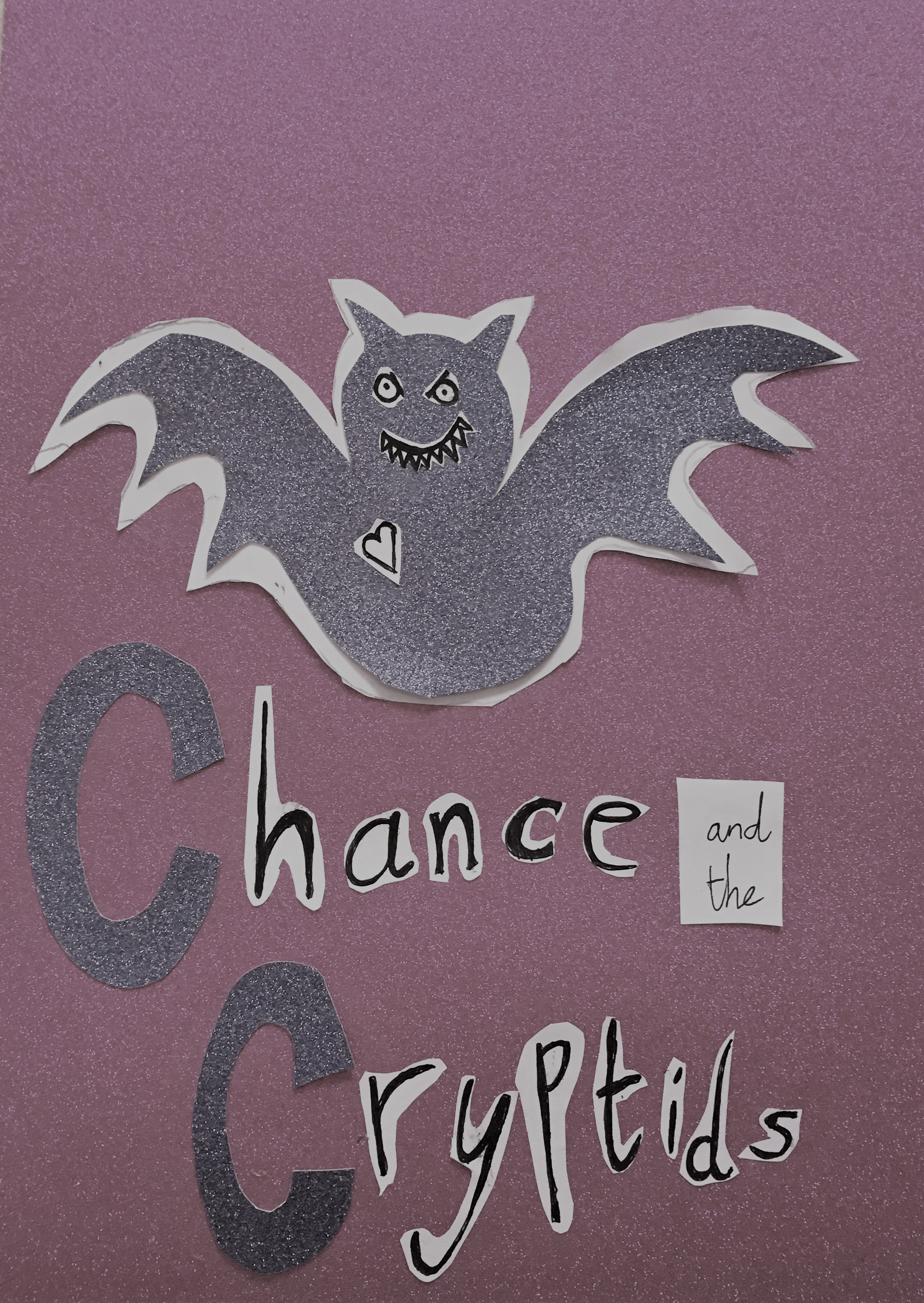
Chance O’Connor loves poltergeists, aliens, werewolves, the Loch Ness Monster, and any other creepy thing you can think of. Frankly, they’re much better company than some people she could name.
As she grows from childhood to adulthood, Chance often views the real world through a supernatural lens. Whether it’s manipulative relatives, unsatisfying work, or boyfriends with feet of clay, there’s a monster for everything. And with some stories, the least interesting question you can ask is whether or not it actually happened.
Chance and the Cryptids is an era-spanning coming-of-age story bursting with humour and goodwill. Think of it as “David Copperfield and Roswell Greys.”


“You’re from Dovecote Gardens,” said the blue girl. It was the kind of sentence that sounded as if it should have a “…right?” on the end, but it didn’t. Maybe it was just really obvious. “And I’m guessing you got here on your own, or you wouldn’t be walking around back here.”
They were standing about four metres apart, Sally and Rube in the middle of the room and the blue girl at the back, all three of them tensed as if they were about to run away. “Do you work for the Iridescences?” asked Rube.
The blue girl snorted. “No.” She said it in the exact same way that girls in Sally’s class did when you asked them if they were gong to sign up for the French workshop at half term. “If I did, you’d all be handcuffed to the wall five times over by now.”
Rube nodded. “Sorry. I had to ask.” She relaxed her arms a bit. Probably not so much that the blue girl would be able to tell, but enough to be obvious to someone who knew her. “My name’s Rube Warbeck. My sister’s Sally.”
The blue girl made a “hmph” noise. “Lor Radiance. And just so you know, the Iridescences have no idea that I’m sneaking around in their house.”
Put like that, it did seem obvious. But like Rube had said, they’d had to ask.
“So… why are you?” asked Rube, “Sneaking around, I mean.”
Lor made another irritated noise. “Why do you think? I’m trying to find out what they’re up to.”
“We’re looking for a man called Colwyn Ballantine. Do you know where he is?”
“Sure.” Lor pointed vaguely behind her. “He’s up in the attic.”
Sally justrestrained herself from punching the air and yelling, I knew it! Just.
“Brilliant!” Rube’s face broke out into the kind of smile that made you think of rainclouds clearing. “Can you help us get up there?”
“Well… that depends.” Lor gnawed on her lower lip. Sally wasn’t sure if she had a really big chin for a girl, or if it just looked like that because she kept pulling weird expressions with her mouth. “What are you planning to do when you find him?”
“He’s our uncle,” said Rube, “We need to get him home.”
Lor let out a long, whistling breath. “That might not be as easy as it sounds.” She motioned over her shoulder again. “Listen… let’s sit down for a moment, I might be able to help you, but… well, things are complicated.”
(To be continued)
If he’d been asked ten minutes ago how he’d react if the Iridescences knocked on the door, Kai would have seen himself flying down and spitting in their eyes, secure in the knowledge that he had Colwyn and his nieces backing him up. But when it actually happened, it was like running into a brick wall at a hundred miles an hour. The only reasonable reaction- the only possible reaction- was to fly away and hide in the furthest, darkest corner of the house.
He just couldn’t stop shaking.
It couldn’t be right for them to be in Dovecote Gardens. Nothing good could come from them being here.
Kai was in a house that contained the Iridescences. He’d been in a house that contained the Iridescences for most of the last fifteen years, but this time it felt like the end of the whole damn world. And so much for spitting in their eye- one look at them had been like gazing into the eye of a massive tornado. Kai couldn’t stop them from whatever they were about to do any more than he could stop the wind from blowing.
But the Iridescences were right here in Dovecote Gardens. Colwyn wasn’t actually here, and Jeanette didn’t know what she was dealing with. He had to do something.
He was small, but not too small to light a match, if he could find one. If he could move. If he could just stop shaking.
(To be continued)

