Alan Sugar May Not Approve (part one)

Monday 

Amber tried to explain that they weren’t allowed outside help, but Cousin Hope wouldn’t listen.  She’d got that stubborn look as soon as she’d heard what Kayleigh Collier had done.

“Right,” said Cousin Hope, putting her hands on her hips, “Run this past me again.  This week’s Enterprise Week, which means that everyone gets a big bag of crap…”

“It’s not all crap,” Amber’s friend Gwen interjected, “Some people get shampoo and makeup, and some people…”

“Like I said, everyone gets a big bag of crap.”  Cousin Hope was twelve years older than Amber and Gwen, so they didn’t argue.  “And for the rest of this week, you’ve got to advertise and sell your particular crap to the Year Eights, but they aren’t allowed to give you any actual money.  Only…  What were they called?”

“Denham Dollars,” said Gwen.  She opened up her bag and took out the paltry nine they’d managed to earn today.  Most of the other groups had got at least thirty.  “Because Mrs Denham’s the head of Business Studies, and it was her idea.”

Cousin Hope picked up one of the Denham Dollars and inspected it.  She didn’t look impressed, probably because it looked more like a purple raffle ticket than actual money.  “Your dad is not going to like that she called them ‘dollars’ instead of ‘pounds’,” she told Amber.

“She only called them that for the alliteration,” explained Amber, “There isn’t anyone in the Business Studies department whose name begins with P.”

Cousin Hope shrugged, and she handed the Denham Dollar back.  “Well, it looks easy enough to forge, whatever it’s called.  All we need is a scanner and a pack of purple construction paper.”

Amber frowned.

Cousin Hope raised her eyebrows.  “Too unethical?”

“Two wrongs don’t make a right,” mumbled Gwen.  She didn’t sound too enthusiastic, but Amber knew she meant it.  Winning the contest by printing off hundreds of Denham Dollars just seemed… cheap, somehow.  Too easy.  It would take all the fun out of it.

“If you say so.”  Cousin Hope clasped her hands together and stretched.  “But we’ve got to think of something, or Kayleigh Collier and her friends will walk away with the prize and never learn a thing.  How many shampoo bottles have you got left?”

They had fifteen.  They’d been given twenty this morning, and they’d actually managed to sell two, early on.  The other three had been the ones Kayleigh Collier had stolen.

If they’d been allowed to choose for themselves where their stalls were going to go, Amber’s group would have done just about anything to avoid being next to Kayleigh’s.  She was one of those people who wasn’t happy unless someone else was miserable.  It didn’t seem to matter who it was- she was just as content trying to trip up the boy with the stammer in Maths as she was pouring Dr Pepper all over Paige Williams’ bag for flirting with a boy she liked.  If there was a small, subtle way of getting at someone, one that wouldn’t cause a huge amount of trouble but would make their day just a tiny bit worse, Kayleigh was in her element.  Amber was pretty sure that Kayleigh did want to win the Enterprise Week contest, but she knew that hadn’t been her only reason for doing what she’d done.  Kayleigh did stuff like that just for the sake of it.

Amber had barely turned her back for two seconds, and when she’d looked back round, her stall had two shampoo bottles fewer and Kayleigh’s had two more.  And, just in case she hadn’t noticed, Kayleigh had looked away and let out a low, snorting giggle.  Gwen had gone straight to Mrs Denham, but she’d been no help.  Kayleigh had given her big innocent eyes, and Mrs Denham had told Gwen and Amber that a poor workman blamed his tools.  And for the rest of the day, Kayleigh had just grinned at them.

Cousin Hope picked up a shampoo bottle, held it between two fingers, and examined it.  “It doesn’t look exactly like the little pots of jellybeans they sell at the corner shop, but it’s close enough.”  She reached into her back pockets, fetched out some change, and handed it to Amber.  “Go to the shop and get me five loads of jellybeans.”  She shook the shampoo bottle.  “We’re going to start watering this stuff down.”

The Fountain

On reflection, Charlene didn’t know why she was surprised.  This kind of thing happened every time she stayed over at Luce’s.

It was three in the morning, and Charlene and Luce were standing around the fountain in the high street.  They were surrounded by closed-up shops and sinister-looking shadows, but the fountain was lit up from underneath and glowing a brilliant blue.  Just as well, or those photos Luce was taking would have been a total waste of time.  She wasn’t even taking them on her phone- she’d brought out one of her dad’s old Nikon cameras especially.  Luce believed in being thorough.

About four metres up, in the pool at the top of the fountain, Charlene’s sister Amber floated on her back, her hair fanning out in the water behind her and her hands crossed over her chest like a corpse in a coffin.  And it was still April.  Charlene just knew that her parents would blame her if her little sister got pneumonia.

“Do you think I’d get a better angle if I stood on that bench?” asked Luce.

Charlene shrugged.  She didn’t know much about camera angles.  She also didn’t know what would happen if a police officer or a security guard came along and saw what they were doing.  Most likely he’d just move them along and tell them that it was far too late for three nice young ladies to be out on their own, but there was just a chance that there was some obscure by-law that meant that mucking about in the fountain was something they could caution you over.  That was the sort of thing that Charlene often worried about when she was out with Luce.

At the top of the fountain, Amber turned slightly towards them.  “Sorry?”

“Don’t move your head, Amber!” Luce called back, “We want to keep your hair looking exactly like it does now.”  Luce turned her back and climbed on top of the bench.

Luce was right about Amber’s hair- it was spread out around her head in a shiny black semicircle, collecting the occasional petal as she floated from side to side.  She was wearing a lacy blue dress that Luce had sworn was hers rather than her mother’s (not that Charlene had ever seen Luce wear any dress, let alone a fancy lacy one), and her lips were painted a dark, wild-cherry shade of red.  Luce had spent most of the evening trying to get Amber’s clothes and make-up just right before they set out.

It had all started when Amber had mentioned the book she was reading.  Well, no- it had all started when Luce’s parents had decided to go away overnight and Luce had asked Charlene and Amber to stay over and keep her company.  But if Amber hadn’t mentioned the book, there was a chance that they would have spent the evening watching films and eating pizza in Luce’s living room.  Maybe not a huge chance, because this was still Luce we were talking about, but a chance.

The book was about a community of homeless kids living in a big city, and Amber loved it.  She’d spent ages telling Charlene and Luce about how exciting the plot was, how much she identified with the heroine, and how she though everyone should read it.  One scene that had particularly captured her imagination involved a character named Jessie, who’d been murdered by a gang of thugs working for the corrupt mayor.  Instead of quietly burying or cremating her, Jessie’s friends decided to break into a park in the rich part of town and float her body in the lily pond, so that she would be found first thing in the morning by some of the rich families who preferred to pretend that the homeless kids didn’t exist.  Amber’s eyes had lit up as she described Jessie’s body floating along like Ophelia, with lilies in her hair.  She’d wondered aloud if someone could try that with the fountain in the high street, which was basically one big oblong on top of a bigger one.  And when Luce was around, nothing stayed hypothetical for long, so here they were.

“You’re doing great, Amber!” called Luce, as the flash went off again and again.

Charlene wondered how long they’d been out here, and how long they were going to stay.  It probably wouldn’t be more than about half an hour.  Even if Luce didn’t get bored, Amber would probably start complaining about the cold before long.  It was just a matter of waiting it out.

Later on, Charlene felt a little guilty for thinking that.  If she’d been concentrating less on waiting and more on keeping an eye on her sister, she might have noticed that Amber was floating dangerously close to the edge.  As it was, she was looking down at the pavement when she heard Luce say, “Hey, Amber, you might want to…  Oh fuck!”

Charlene looked up just in time to see Amber float over the edge and fall, face-first, into the water below.

&&&

In the end, they were lucky.  Amber’s nose stopped bleeding after a minute or two, so they didn’t have to go to A&E.

“Well, we managed to get some good photos out of it…” said Luce by way of apology.  She’d spent most of the walk home delicately hovering around Charlene and Amber, as if she was worried that getting too close would lead to a kick in the shins.  Charlene hadn’t yet decided whether it would or not.

“It would have been OK if we’d had an anchor,” said Amber.  She was still wet through.  Luce had lent her her jacket for the walk home, at Charlene’s insistence.

“Hmm,” said Charlene.  In between checking her sister’s nose for signs of swelling (or anything else their parents might notice), she made a mental note to borrow Amber’s book at some point tonight.  If there were chapters later on where the heroine got tied to the railway tracks or set herself on fire, it was best to know while she still had a chance to tear some of the pages out.

Hubert: the Musical!

Last week, I was at karaoke, singing “Happy Hour” by the Housemartins (because, as we’ve established, I’m cool like that), when I noticed something about the lyrics.  What with the lines “where the haircuts smile / and the meaning of style / is a night out with the boss” and “he tells me that women grow on trees / and if you catch them right they will land upon their knees,” it could be a theme song for anybody who has ever had to put up with the Hubert Puberts of the world.  So I decided to put together a Hubert-themed playlist, as a (hopefully) final goodbye to girls and all who sailed in her.

“Help The Aged” by Pulp:  A song about what Hubert wants in a relationship (“give a hand, if you can / try and help them to unwind / give them hope and give them comfort / cause they’re running out of time“).

“Material Girl” by Madonna:  What Hubert imagines that women see in him (“cause the boy with the cold hard cash / is always Mr Right“).

“Now You’re A Man” by DVDA:  I’m not going to spoil the lyrics for you- just click on it and listen for yourself (but not if you’re around small children).  It’s very Hubert, especially the second verse.

“See You Later, Alligator” by Bill Haley and his Comets:  In honour of the heroic alligator farmer early on in the book.

“Pretty Vacant” by the Sex Pistols:  An accurate description of Hubert’s dream woman.

“Jilted John” by Jilted John:  What happens whenever Hubert makes the mistake of competing with a man who has actual positive traits, such as the alligator farmer or Clay the copper (“Oh, she is cruel and heartless / to pack me in for Gordon / just cause he’s better looking than me / just cause he’s cool and trendy“).

“Baby One More Time” by Britney Spears:  OK, the lyrics don’t have much to do with Hubert, but the song was obliquely referenced in the book itself, so it seemed worth putting in.  Plus, the video features a pretty eighteen-year-old dancing around in a school uniform, so Hubert probably watches it on repeat constantly.

“Perfect” by Alanis Morissette:  Hubert’s vision of ideal parenting (“don’t forget to win first place / don’t forget to keep that smile on your face“).

“He’s Misstra Know-It-All”” by Stevie Wonder:  A depiction of Hubert’s business practices (“makes a deal / with a smile / knowing all the time that his lie’s a mile“).

“Stacy’s Mom” by Fountains of Wayne:  In honour of Hubert’s strange, five-year-old-harassing friend (“and I know that you think it’s just a fantasy / but since your dad walked out, your mom could use a guy like me“).

And, of course, “Don’t Stand So Close To Me” by The Police.

(I’m sure we all wish that Hubert would take the title literally.)


girls (part ten)

Unfortunately, I will be unable to continue my reviews of girls, as I seem to have destroyed my copy in a fit of rage.

holes

(Let’s just say the plot was full of holes.)

It was that dig at Lolita that finally did it.  When your first novel is a blatant knock-off of another, much better-known, book, it’s probably not a good idea to throw in sneering references halfway through.  It’s not even as if Lolita’s one of my favourite books, but there’s a reason that it’s considered a Twentieth Century classic while girls was on sale for £1.99 in The Works less than two years after its first printing.  For one thing, Vladimir Nabokov actually gave his characters names.

Beyond that, I just couldn’t stomach another moment in this strange parallel world where justice and compassion are a myth, nothing is more important than money and power, and all men secretly want to go to bed with twelve-year-olds.*  I suppose you could interpret my giving up as evidence for J.T. LeRoy’s quote about the razorblades pressing in too close, but, by that logic, the same is true of YouTube comment sections, because I’ve given up reading those as well.  Saying the most infuriating thing you can possibly think of doesn’t automatically make you worth listening to.

I’m sure that, at some point in the last sixty pages, there was some kind of plot twist in which Hubert and Business Cat realised exactly how moronic everything they’d said, done and thought so far truly was, but it had got well past the point where it would have been worth it.  Quite apart from the horrible characters, the book was a load of pretentious wank that seemed to think that disconnected musings about anything that came to mind was the same thing as being profound.  People make fun of E.L. James for essentially publishing her fanfic, but I think Nic Kelman might have essentially published his dream journal.

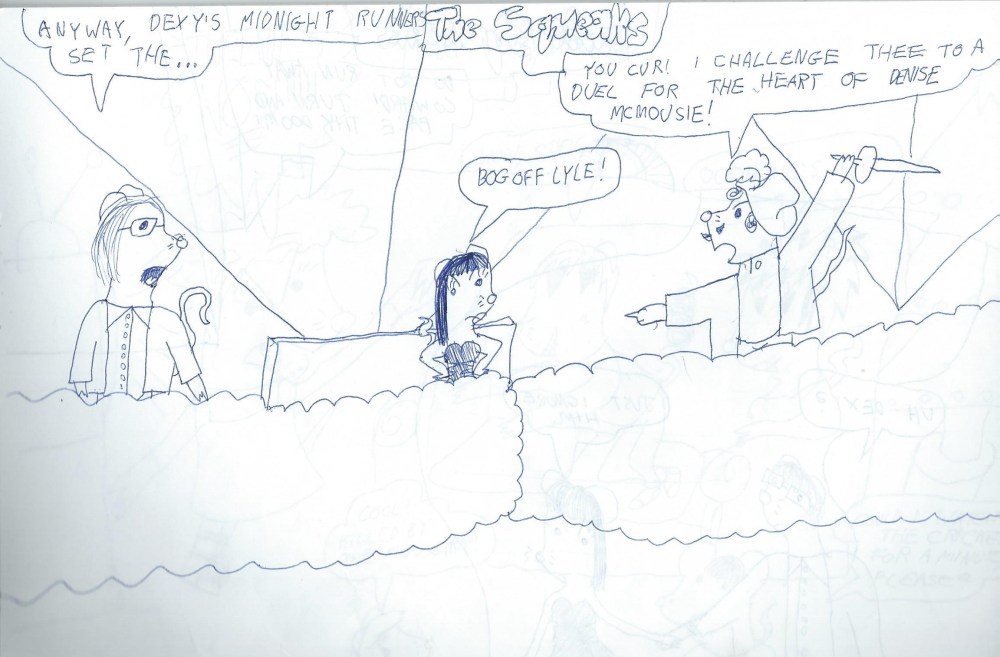
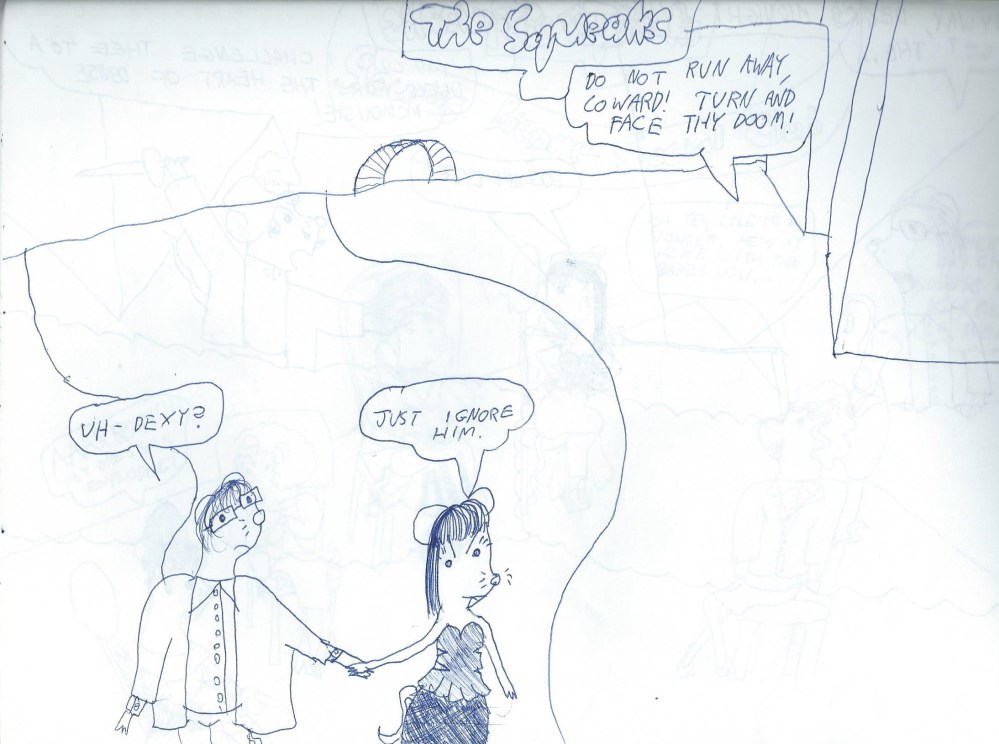
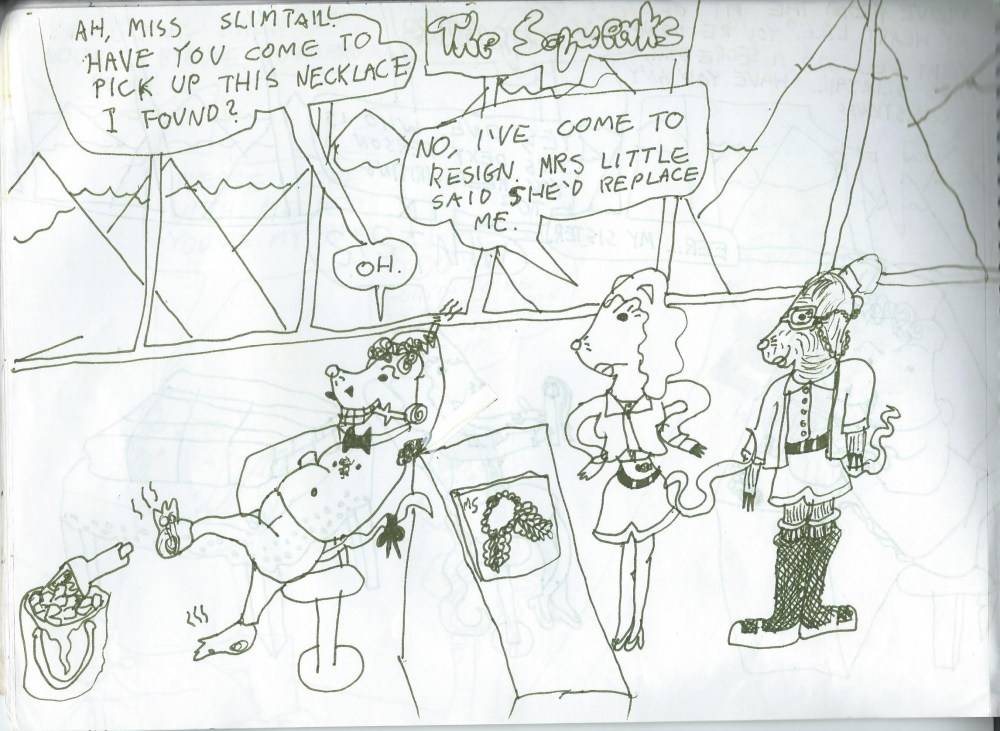
My only regret is that I now have no excuse to post any more of my silly mouse drawings.  But I’m sure I’ll survive.


*True, I am not myself a man, nor can I read their minds, so I don’t have any definite proof that they don’t.  But I’d say that, in a case like that, the burden of proof is really on the person making the claim, wouldn’t you?

girls (part nine)

 (pages 127-149)

Hubert’s at a nightclub with his girlfriend, feeling insulted when the DJ describes a ten-year-old song as a “classic.”  Look, if calling “I Predict A Riot” a classic is wrong, then I don’t want to be right.  He is taken aback to see a thirteen-year-old girl wearing an obscene T-shirt.  I’m not sure if the implication is that he’s having a sudden attack of conscience, or if it’s that he’s thinking, “See?  Teenagers talk about sex sometimes!  Therefore I am completely justified in trying to have highly exploitative sex with them!”

Hubert likes young girls because they’re the only ones who aren’t scared of him.  I think he’s mixed up “scared” and “repulsed.”

He meets a PVC-clad goth girl, and stares at her boobs.  He sees her again a couple of times throughout the evening, which makes him think about how fat his girlfriend is going to get as she gets older.  Hubert himself is already middle-aged and bald, but apparently that’s not important.

The band they’ve come to see pulls fourteen-year-old boys up on stage, gets them to take their shirts off, and encourages the audience to ogle them.  Hubert is turned on.  He is NOT GAY, you understand, just happy for the boys because they got to be felt up by older women.

Hubert has a friend who regularly goes up to five-year-olds and tells them how much he fancies their mothers.  Strangely, this friend isn’t in jail.

There’s a bit about women in Russia who resorted to prostitution after the Soviet Union collapsed, and how men would flock to Russia for the chance to humiliate a well-educated woman who now couldn’t get a job.  The narrator (who is presumably neither Hubert nor Business Cat, owing to this whole bit being in third-person) worries that some of these women might have faked their qualifications, meaning that the poor men who wanted to degrade a former university professor were tricked into degrading a former shop assistant or something.   Unethical business practices are a terrible thing.

Business Cat’s wife redecorated their flat while he wasn’t there.  How very dare she.

Hubert once had a dog.  Sorry- Hubert might have once had a dog, since saying anything happened for certain would be dangerously close to having a plot, and we can’t have that.  Anyway, Hubert loved his hypothetical dog, but worried that one day he and his dog would swap places and the dog would be the one to decide where he ate and slept.  I’ve got to say, I’d probably trust the dog’s judgement more.

Hubert’s now been divorced twice.  Big shocker, I know.  He asks his friend how his marriage has lasted so long, and it turns out that it’s because his wife lets him have threesomes with eighteen-year-olds.  This is getting really monotonous.

Back in university, Hubert set his friend up with a girl so that he could lose his virginity.  We find this out in the first sentence of this section, but Hubert still takes a page and a half to tell us.

The Romans didn’t believe in Justice more than the early Greeks, they simply realized its usefulness.  They realized while a man fights well for something he wants, he fights even better for something he thinks he deserves.”

DL1

Everyone is afraid of Hubert, even his parents.  He thinks it’s because he’s become so rich and powerful, but I think it’s just because he’s Hubert.

Oddly enough, there’s now a bit about Lolita.  I swear I didn’t know this before I wrote the last post.  Anyway, apparently Nabokov wimped out by making Lolita twelve rather than, say, eight, because that made the book less shocking, because we all know that all men fancy twelve-year-olds anyway.  I think Nic Kelman might have missed the point of the book.

Business Cat denies that he hates women.  No, you just want to make them into lobotomised sex-dolls who conveniently disappear as soon as they turn thirty.  Nothing hateful about that.

DL7

girls (part eight)

(pages 110-127)

DL11

More than once over the last couple of weeks, I’ve described this book as “a bit like Lolita, only crap.”  Of course, the important thing about Lolita is that it has an unreliable narrator, a guy who convinces himself that he’s a bold romantic hero, only to realise near the end of the book that he’s actually just a scuzzy little sexual predator who has ruined the life of the girl he claims to love.  I’m looking forward to Hubert and the first-person narrator having a moment like that.  I hope they’re going to, anyway, because at the moment girls is looking an awful lot like a literary version of this.

Speaking of the first-person narrator, I’m still not sure what to call him.  I’m torn between King Dong (because of his great thoughts on how men have more in common with gorillas than with women) and Business Cat.

Hubert’s employees gossip about him behind his back.  You would too, if your boss was Hubert.  Specifically, they talk about the time he fell out with his business partner, who then shot himself.  Honestly, that strikes me as the least gossip-worthy thing about Hubert, but to each his own.

We also find out that Hubert’s wife has left him.  Good for her!

Something about Paris killing Patroclus in The Iliad.  You know, I think I’m going to skip the Iliad quotations from now on, unless they’re particularly juicy.  They rarely have anything to do with what’s actually going on in the story.  Such as it is.

Hubert is travelling the world, eating guinea pigs.  As if we didn’t already know that he was history’s greatest monster.  Oh, and he also finds kinship wherever he goes with other men who like to sleep with teenage girls.  It’s nice to find something that transcends cultural borders.

Business Cat (it’s the classier option) talks about his wife kissing him goodbye in the car instead of in front of his mates, who might make fun of him.  The he talks about the origins of the C-word, and how it was Homer who started using it as an insult for women, so blame him.  It’s funny; where I come from, the C-word is almost always used as an insult for men, not women.  In fact, for a few years in the early 2000s, I only ever heard it applied to Tony Blair.  It was like his own personal insult.

Also, the C-word is related to “cunning,” which makes sense because women are crafty bitches.  Trufax.

Hubert has a female friend.  I know- I’m as surprised as you are.  The book does specify that she’s the only one, though.  I mean, let’s not go nuts.  He’s surprised to find that he’s attracted to her, even though she’s his age.  Surreal!

He doesn’t enjoy sleeping with her, though, so that’s alright.  It turns out that she also has a thing for teenagers, and enjoys it when her boyfriends end up sleeping with Hubert’s girlfriends.  The phrase “wind them up and watch them go” popped into my head when I read that bit, and I’m still shuddering.  But still, Hubert looks down his nose at her because she just sleeps with teenagers for “aesthetics,” not for philosophical reasons like he does.  Hubert the hipster perv!

Hubert denies hanging around outside local schools.  He very specifically denies it.  Why would you suggest such a thing?  Honestly…

Let’s see…  Men admire villains because they dominate people…  Hubert used to believe that his face would stay that way if the wind changed…  Business Cat associates his wife with temples…  I’m not seeing much of a connecting theme, here.  See, this kind of thing is what I mean by “like Lolita, only crap.”  Lolita had an actual plot.

Finally, Hubert meets a gay person who is into teenagers as well, which makes Hubert decide to extend the hand of brotherhood.  It’s a beautiful story of social acceptance.

DL3

girls (part seven)

We’re nearly at the halfway point now, and, so far, I’m not seeing the transgressive beauty that J.T. LeRoy and the others were raving about on the back cover.  If you’re just joining us, we’ve been through ninety pages of Hubert Pubert and the first-person narrator, who may or may not be a) the same person or b) intended to be remotely sympathetic, trying to compensate for their many, many inadequacies by dating girls who are too young and naïve to realise they could do better.  Occasionally they wax lyrical about how they are men and therefore warriors and they seek power as their birthright.  If I wanted to read in depth about people like that, I’d spend an hour looking through the We Hunted The Mammoth archives.

DL12The above is a cartoon I drew when I was fourteen.  Clearly, my Year Nine rough book deserved excited back-cover cover quotes from memoirists who fib a lot.
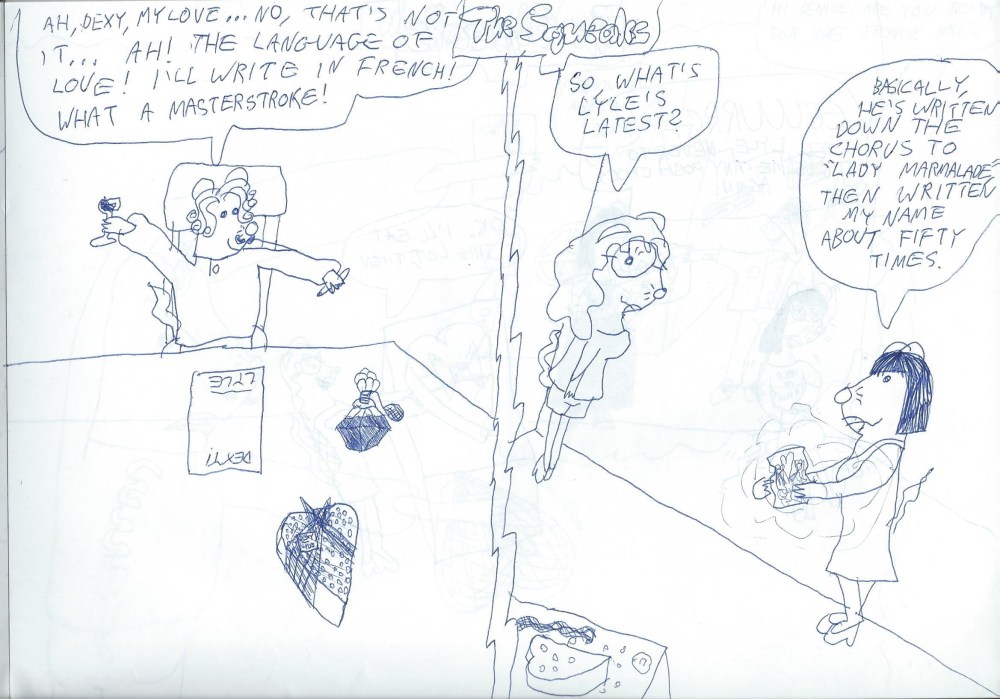
Back in the book, Hubert reminisces about his bisexual ex-girlfriend and how they once had a threesome with her ex.  Then there’s a bit from The Iliad about a guy whose mother made him seduce his father’s mistress in order to stir up trouble.  Now why can’t I be reading that story instead of about boring old Hubert?

Hubert compares his girlfriends’ political beliefs to small children getting excited about pointing out fire hydrants.  You might think that this is patronising, but when you know what’s coming up in a few sections, you’ll see that it’s actually horrifying.

Hubert has a daughter who is older than his girlfriend.  He makes her work his law firm, within reach of his slimy friends.  Ick.

There’s a bit about the lamia, who is known for drinking men’s blood.  And yet I know that this book isn’t going to end with Hubert and his mates being exsanguinated by one, so why are you taunting me, Nic Kelman?

The first-person narrator blames his divorce on the fact that he and his wife never went to museums anymore.  Nothing to do with the fourteen-year-olds, then.  Sooner or later I need to come up with an insulting nickname for this guy, too.  What can it be?  Herbert the Pervert’s already taken.

There’s a bit about how proud Hubert’s dad was that he was a total horndog as a kid, and another bit about strippers and porn stars and how they’re actually complex human beings, you know.  As long as they’re under thirty, I guess.

(Actually, I completely agree that it’s wrong to dismiss somebody’s intelligence and worth as a human being just because they’ve got a slightly raunchy job.  It’s just that when someone like Hubert tells you how intelligent and grounded most strippers are, it always comes with the implication that, if you were intelligent and grounded, you too would give him a lapdance whenever he asked.)

Hubert is in Amsterdam.  Guess what he’s doing.  Go on, guess.  You know, in How Not to Write a Novel, they warn against something called “The Second Fellatio in the Laundromat”; i.e.- when one sex scene is functionally identical to another one earlier in the book, and only really exists to provide padding.  That’s this scene in a nutshell.  This prostitute is also underage (or rather, would be underage in the US, where Hubert lives), and Hubert again congratulates himself on being so adventurous.  He reflects that she was probably abused as a child, and also that she’ll be surprised when she’s twenty and men find her less attractive.  He gives her a bit more money than he needs to, by way of charity.  I’m pretty sure Hubert’s still alive at the end of the book.  There’s no justice.

There’s a sentence that begins, “There is so much sociobiology I cold bore you with.”  For “could,” read “will,” and for “bore you,” read “make your synapses shut down in self-defence.”  But anyway, apparently men have more in common with gorillas than they do with women.  Well, gorillas have tiny penises, so that’s true for Hubert, at least.

Hubert’s friend is dating an eighteen-year-old model.  Hubert is also dating various eighteen-year-olds, but becomes jealous when he hears that his friend’s girlfriend collects cuddly toys and makes him “pinkie promise” to call her.  She’s so childlike and charming!  That’s totally not a creepy thing to find attractive in somebody already younger than your daughter!

(I’ve never once met an eighteen-year-old who used the phrase “pinkie promise.”  Honestly, I’m not sure I’ve met anyone over thirteen who used it.  And then only the really annoying thirteen-year-olds.)

Hubert’s friend feels a bit guilty for dating an eighteen-year-old, but Hubert thinks, “When he realises that this is something he not only needs but deserves, he’ll stop feeling bad.”  In Hubert’s worldview, his friend deserves to be with an eighteen-year-old girl who talks and acts like she’s twelve.  This is what the universe owes him.  I’ve read books about actual, real-life serial killers that have creeped me out less than this.

More from The Iliad.  Achilles wants to kill Helen for turning men against each other.  Bros before hoes, eh?  Meanwhile, Hubert is impressed by another friend’s beautiful, subservient girlfriend, and even more impressed that said friend is secure enough in his relationship to call her fat in front of his friends and refuse to acknowledge her otherwise.  Finally, we find out that the divorce rate for veterans in the US is no higher than the national average.  Good for them.

The first-person narrator says that it’s a parent’s job to teach children to be competitive.  In particular, it’s their job to teach their daughters to compete with other young, pretty girls for the attention of old, grimy men.  Seriously, My Friend Dahmer is a million times less creepy.

There’s then a bit about Elizabeth Bathory, who is also not going to kill Hubert.  Granted, I’m probably going to see every character who is introduced from now on as yet another person who isn’t going to kill Hubert, but I know for a fact that Elizabeth Bathory has both the means and the motive.  It’s a shame to see a genuine talent go to waste, that’s all I’m saying.

And with that, we reach the halfway point, and I think I’m going to take a break from this for a week.  This book is seriously getting me down, and this was the worst section yet.  There’s only so much time you can spend in the head of a misogynistic borderline-paedophile before you start to lose faith in humanity.  I’m going to spend some time with The Restaurant at the End of the Universe, reminding myself that sometimes books have an actual plot, sometimes characters aren’t completely reprehensible in every way, and sometimes sentences contain actual humour instead of condescending pretension.

The average Vogon will not think twice before doing something so pointlessly hideous to you that you will wish you had never been born- or (if you are a clearer-minded thinker) that the Vogon had never been born.”

Ahhh.  See you next week.

DL4.jpg

girls (part six)

We discover that Hubert doesn’t enjoy sex unless the women he’s with let him rough them up a bit and call them whores and bitches.  Surprise.  He also acts sniffy about the concept of “women’s liberation.”  Double surprise.  I mean, it is a movement based on convincing women that they have options in life beyond catering to the whims of Hubert and his pals.  I can see how that would annoy him.

The first-person narrator remembers buying a house with his wife, resenting the fact that she chose most of the furniture, and having sex in every room.  Following this, it’s The Iliad again, with Achilles lamenting over Briseis.  Then Hubert worrying about his love-handles.  One of these things is not like the other.

Also, it’s OK to cheat on your wife because everybody does it.  And rich men pay assistants to distract their wives from the fact that they’re cheating on them, so that’s doubly OK.  Good to know.

Hubert wanks over a photo of his underage girlfriend.  We finally have a confirmed age for him- forty-two- which just makes me wish I was reading Hitchhiker’s Guide to the Galaxy right now.  Arthur Dent is more man than Hubert will ever be.

More from The Iliad, then we have Hubert on holiday with his long-suffering wife.  He has a fancy new camera.  He is very proud of his fancy new camera.  His wife shows off the fancy new camera to another couple.  Hubert suspects that the husband is jealous because he cannot buy his own wife a new camera as fancy as this one.  After they’ve gone, Hubert’s wife refers to then as “a nice couple,” but Hubert knows his wife is foolish, because the husband is jealous of his fancy new camera.  This is beginning to sound like something from Clickhole.

There’s a bit about people going to see graveyards and monuments while on vacation.  I think it’s supposed to be profound.

Hubert goes to New Orleans.  You have probably guessed that he meets a beautiful young woman who is inexplicably attracted to him, and you would be correct.  Her name is Elena, and he knows her from a modelling shoot a few years ago.  We’re told that he only went after her because she’d been seen with another man previously.  I’m not sure if we’re meant to read this as jealousy or homoeroticism.  Could be both.

In the present day, Elena seems upset about something.  She married the other man instead of Hubert, and now he cheats on her.  Hubert, meanwhile, has a much younger girlfriend who thinks Elena’s top is too low-cut.  The moral of the story is, never dump Hubert.

The first-person narrator and his wife skip work and go for a romantic drive.  He assures us that he never really loved her.  There is then a discussion of the various meanings of “love,” and how it’s really about owning things.  Woman are things, after all.

girls (part five)

(pages 48-71)

There’s a description of a sixteen-year-old pop star who is totally not Britney Spears, what gave you that idea?  She denies being a sex object, and “you” laugh, because she wears short skirts and therefore only exists to titillate middle-aged men.  Stands to reason.

“You” reflect on “your” midlife crisis, and how bungee-jumping didn’t make you feel alive but sleeping with an underage prostitute did.  You know, it’s getting kind of tiresome, typing “you” over and over.  If the book doesn’t give this second-person character a name soon, I might have to give him one myself.  I’m thinking something along the lines of “Hubert Pubert.”

We then get another quote from The Iliad, with Helen describing herself as a “nasty bitch.”  Cheer up, Helen- you’re not half as nasty as old Hubert here.

Hubert takes a younger woman he plans to sleep with (is there any other kind?) into the Versace Boutique to buy her stuff.  The manager won’t let them in while they’re eating pretzels, so Hubert bribes and bullies him into doing so.  Hubert inwardly laughs at the manager for allowing him such a victory, but is then insulted that the girl finds it funny.  Hubert doesn’t have much of a sense of humour, I’ve found.  Then there’s a quote from General Lee on the nature of war.  Because acting like an entitled dweeb in a clothes shop is exactly the same as leading men into battle.  At least Hubert wasn’t doing it to defend his right to keep slaves, I guess.

Back to the first-person narrator, who also doesn’t have a name yet, remembering himself and his wife being scared by a mouse on their wedding night.  His wife asks him to deal with it, so he smashes its head in with a table leg.  Again, also not the same thing as going into battle.  Maybe if the mouse was armed with a bazooka.

Another quote from The Iliad, with Aganemnon resolving to give Briseis back to Achilles, and then we have Hubert deciding not to discuss his business practices with his girlfriends, so as not to sully their innocent minds.  One of these girlfriends was an underage prostitute.  I’m never going to get tired of pointing that out.

There’s a bunch of statistics regarding the sex industry, concluding, “All told, the American male is clearly not getting what he wants at home.”  Not least because what he wants is teenage girls to fawn over him, and, in real life, they’re annoyingly reluctant to do so.

At work, Hubert wears a bracelet his girlfriend bought him, and is embarrassed when his friends notice.  Hubert imagines that the teenage girls he letches over are just as interested in him, and that their frustrated, cheated-on mothers are angrier with them than they are with him.  The first-person narrator is angry that his wife taught him a trick for using vending machines, and now he can’t ever forget about her because it will mean forgetting how vending machines work.  This is the kind of thing they’re comparing to a ten-year battle against Troy, by the way.

There’s a list of words to do with love and addiction, thus comparing the two.  This is a very original thought.

There is then a strange section that states that people who grow up in poverty and whose sisters become disabled because of this are luckier than people whose children don’t end up at the right university, because they’ve found out earlier on that the world is a harsh and cruel place.  Also, making lots of money and only dating women who are too young to see what an idiot you are is exactly the same thing as “lead(ing) armies into Gaul.”  Just watch out for those bazooka-wielding mice, I guess.

There’s a section that begins:  “Have you ever seen a domesticated dog with its first bone?”  I’m not sure why the narrator felt he had to specify “domesticated.”  Maybe he was worried that the readers wouldn’t know what a dog was.

Hubert is admiring his expensive new car, congratulating himself for not being one of those stupid people who refers to cars as “she.”  There are problems with work, but, on the bright side, he seems to have a wife now.  She doesn’t nag him like his friends’ stupid, awful wives, but he’s still unsatisfied.  Probably because she’s not fourteen.

Hubert drives away from his house to a nearby bar, where a group of college girls ask him about his career and hang on his every word.  They are impressed by his house and his car.  One of the girls takes him back to her room, and is much better in bed than his wife.  Geez, and people called Twilight wish-fulfilment…

girls (part four)

(pages 32-48)

It occurs to me that, in a previous entry, I said that this entire book is in second-person.  After my first flick-through, I genuinely thought it was.  But then, a few days ago, I hit a first-person section and realised my mistake.  It would really have been more accurate to say, “more of this book than I can tolerate is in second-person.”  Camel Without enterprises sincerely regrets the error.

We’re back to “you,” and “you’re” at a birthday party, fantasising about setting fire to the other guests.  Between this and the shooting fantasies earlier, I think “you” could do with a week or two of anger management.  Unless that was a different “you”- it’s hard to tell.  So far, the only character who has had an actual name has been the underage prostitute.  Her name was Jin.

“You” are out with “your” girlfriend, and preparing to meet an old high school friend.  Judging by the incredibly subtle Achilles/Briseis/Aganemnon-related foreshadowing earlier, I anticipate that the old high school friend will try and steal “your” girlfriend.  Apparently the friend was on the school football team.  Yep, definite girlfriend-stealing ahoy.  Maybe one of you will feed the other one to the alligator-farmer’s alligators.  I’d like that.

Hey, we have actual names!  Two of them!  The girlfriend is called Penny, and the high school friend is called Clay.  Penny asks Clay questions about his career with the police, and gets him to tell her embarrassing stories about “you.”  Instead of getting jealous, “you” start to have weird fantasies about watching Clay and Penny have sex.  That I did not expect.

Clay’s missed his train, so “you” invite him back to “your” place.  This leads to a threesome.  It gets quite homoerotic.  “You” go to sleep, patting “yourself” on the back for being so sexually adventurous, and then Penny sneaks off to have some more sex with Clay while “you’re” asleep.  They agree not to tell “you” about that part.