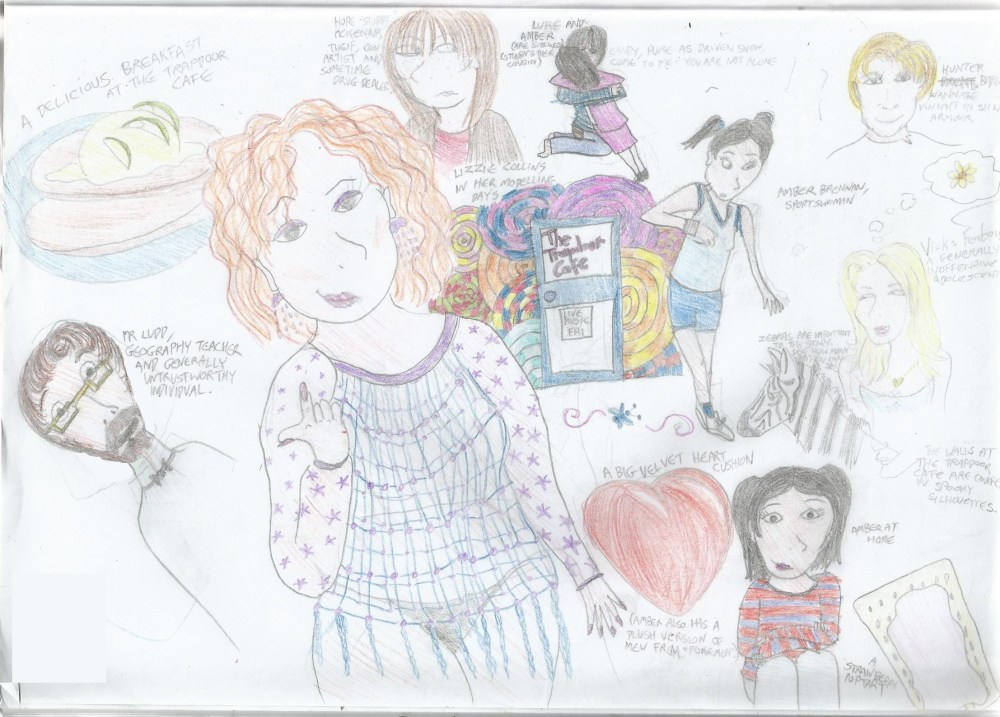
Now That April’s Here

If you’re happy and you know it, thank your ex!  All you really need in life is someone who sees the psycho you are and likes you anyway.  It’s important to be yourself.  People don’t have to like you… and you don’t have to care.

As we grow up, it becomes less important to have more friends, and more important to have real ones.  You see, I’m a nice person, so if I’m a bitch to you, you need to ask yourself why.  I don’t have a short temper- I just have a quick reaction to bullshit.  I literally love being at home, in my own space, not surrounded by people.  Sometimes it takes me all day to get nothing done.  And maybe that’s not surprising- after all, I’m so old, I can remember going through a whole day without taking a picture of anything.

And I’m sorry if anyone’s upset at finding out that the world doesn’t revolve around them.  Here, let me pour you a nice cup of Get the Fuck Over It.  Personally, though, I’m doing my part to conserve water by drinking wine instead.


(Edited to add:  This was an April Fool’s joke.  Those Facebook memes sound really aggressive when you string them all together.)

The NHS versus the Weasels

I’m going to have to repeat what I said on Facebook:  What fuckery is this?

https://www.opendemocracy.net/ournhs/richard-grimes/government-moves-to-consider-nhs-user-charges

Now, I’m not stupid- I know this isn’t exactly an unbiased source.  I know this article was written last July, and a lot of things have changed since then (Jeremy Corbyn things!).  I know my Facebook feed is largely made up of hardcore left-wingers, which means I’m probably primed to accept any story that makes David Cameron look bad.*  And I know these quotes could easily have been taken out of context- maybe every other peer in the room responded with shouts of Eh?  What are you smoking? and the article just didn’t mention it.  But a) I doubt the writers made these quotes up out of whole cloth, and b) the fact that they were even brought up with a straight face should provoke howls of rage in the citizenry.

I mean, just look at these things.  It’s not even just the Tories:

 Another Labour peer, Lord Desai, suggested bizarrely that patients should be issued with an “Oyster card” which is deducted whenever a patient uses healthcare, and patients should receive a “bill” at the end of the year, saying this would “help make it clear to people that a free National Health Service is not a costless one.”

In other words, “let’s charge sick people for getting sick.”  You know, the exact thing the NHS was created to avoid.  (Also?  “Free” and “costless” mean the exact same thing, numpty.)

It’s a terrifying vision of a dystopian future- attempts to take away our rights couched in weasel words like “begin the process of helping the public engage in a discussion,” just to add insult to injury.  But luckily, Britain is still a democracy, and our MPs all have email accounts.  Let us join forces and spam them into submission.


* Although David Cameron himself hasn’t exactly helped in this regard- not one of us saw Piggate coming.

The Tale of the Bisected Snake

(A story I wrote with my friend Pippa a few years back.)

Once upon a time, there was a snake in the middle of the desert.  Although he was a beautiful creature with bright green scales, he was sad.  You see, some time ago, an explorer walking through the desert had put a tentpole through the snake’s body, cutting the end of his tail in half.

This made the snake feel victimised, so he went to see his lawyer to see if he could claim compensation for the injury, as he felt he was not to blame. However, the lawyer said that he was silly, as he was bright green, and this was not a very good colour for a desert snake. As he was not even trying to blend in with the desert, he was to blame for the incident, for being a vain and ignorant snake.

Feeling that the lawyer was not being sensitive to his needs, the snake promptly ate him.  He then went on his way, looking for other methods of revenge.

Coming to a square in the centre of town, he saw a protest against the use of the word “antidisestablishmentarianism” on TV.  The protesters claimed that said word was too long and nobody knew what it meant, making millions of innocent people feel stupid.  The snake watched them wave their signs about, and felt a tear come to his bright yellow eye.

“These people are the victims of unfairness, much like myself,” he thought, “I shall join them in their quest for justice!”  And with that, he swung from a lamppost onto a nearby statue, and began to sing a selection from Les Miserables.

Unfortunately, this was the wrong choice, as the crowd was against anything related to the theatre, which meant he had to slither away as fast as he could and hide up a drainpipe until the mob (who had somehow found pitchforks and lit torches) had passed.

Even more unfortunately, the split in his tail meant that he could not hide himself fully in the pipe! The bisected part stuck out the end! Some eagle-eyed member of the mob spotted this, but could only persuade his group of five friends to come with him to investigate it, leaving the rest of the mob to pass by and  fall into the river which passed by the end of the road.

Not wanting to be caught by these six ruffians, the snake slithered out of the drainpipe and ate the ringleader.

“Gasp!” yelled his friends, “You ate our friend Cliff!”

“Yes, I did!” snapped the snake, “He was going to kill me just for singing showtunes!”

“But…  But…  We loved him!” wailed Cliff’s friends, their eyes brimming with salty tears.

“Listen!” said the snake, “You think you’ve got problems?  An explorer cut my tail in half, and then my lawyer…”  But the rest of the snake’s sentence was drowned out by the ruffians bawling over their dear departed friend Cliff.

“Shut up!” yelled the snake. And he regurgitated the clothes the gang leader was wearing into a heap in front of the rest of the group. As the five big, burly men stared, tears drying on the cheeks of their shocked faces, he knew it was time for a quick get-away.

With angry (but somewhat watery) shouts echoing along the alleyway behind him, the snake sped off, taking as many twists and turns as he could in an effort to lose his pursuers. As luck would have it, he turned around a corner and saw his salvation.

For there, in a yellow suit and hat, stood the very explorer who’d bisected his tail in the first place!  The explorer was cutting the ribbon at the opening of a new wing in the hospital, so he was completely distracted.  The snake grinned.  Vengeance would be his!

With a strangled cry, the snake launched himself off the ground and at the explorer, jaws wide open in preparation for the extremely satisfying meal he was about to have, when suddenly…

The explorer turned, alarmed by the commotion caused by the arrival of Cliff’s gang. Seeing his imminent demise in the shape of the bisected snake, hurtling towards him with reckless speed, the explorer drew a katana and the whole crowd went quiet.

The explorer and the snake froze, looking at each other, watching for the signs that indicate impending movement. Suddenly they were both distracted by an appearance from the lobby of the hospital.

“What is the meaning of this?” bellowed Pythia, the goddess of snakes, who had just materialised in the lobby.

The snake bowed (which was more difficult than you might expect, since he was floating in the air mid-jump).  “Your holiness, this man cut me in half with a tent peg!  Ever since then, I’ve had to go around with a bisected tail, which makes it hard for me to hide in drainpipes, among other things.”

“Is that so?” asked Pythia, turning an angry eye on the explorer.

“How was I to know that there was a snake underneath my tent peg?” the explorer exclaimed defensively.

“I’m bloody bright green, aren’t I?” the snake roared, turning an angry eye on the explorer. “I should be easy enough to see in a desert, shouldn’t I? I’m not exactly camouflaged!”

“But I’m colour-blind!” wailed the explorer.

“I think I can see a way through this predicament.” This was hesitantly said by the new leader of Cliff’s gang (who was named Philip), as he picked his way through the crowd to the steps in front of the lobby. He looked nervously at the still-floating snake as he did so, as if expecting him to swallow him whole for daring to speak.

Which he did.

“Oh, that’s just great!” said the explorer, “He was about to solve all our problems!”

“Well, I’m sorry!” said the snake, “I was just going by my instincts!  And as for you, you allegedly colour-blind twit, I think I’ll eat you for dessert!”

Meanwhile, Pythia had been thinking.  “You know, snakey, if the explorer couldn’t see you, then that renders your lawyer’s argument completely invalid.  It didn’t matter that you were bright green, and therefore you can’t be blamed.”

So the snake and the explorer joined forces to sue the lawyer’s surviving family for a million pounds, completely bankrupting their law firm and sending them into the poorhouse, and then moved to the Bahamas and lived happily ever after.

The End

“Shut Up and Sing”

I decided to write this post after seeing the front page of yesterday’s Sun (where they told Emma Thompson to “shut (her) cakehole” for daring to express an opinion contrary to theirs), but the subject matter’s been a sore point with me for over a decade.  Ever since the end of 2004, when I read a letter in Q about R.E.M., Pearl Jam and Green Day’s attempts to stop George W. Bush from being re-elected.

The letter-writer talked about the “crushing inevitability” of the US election result, and how there was “nobody more delusional” than a musician who imagined he could somehow influence political matters.  He concluded by telling the three bands in question to “stick to the music- it’s what you’re best at.”  What really got to me, though, was the editor’s reply: “They all care deeply about the issues.  The fact that they all had new albums coming out had nothing to do with it.”

Never mind that R.E.M. and Pearl Jam had both been deeply political for most of their long careers (the former even including voter registration forms in the liner notes of Out Of Time in 1991.)  Never mind that Green Day were at the height of their success in the mid-to-late 2000s, and therefore probably didn’t need any extra publicity.  Never mind that all three bands lived in the USA and the result of the election was quite likely to affect their day-to-day lives.  Clearly, the only mature way to react to adversity is to accept it as a “crushing inevitability” and ignore it.

I hate the “shut up and sing” argument.  Hate it like burning.  People talk blithely about how sick they are of hearing about politics and how they listen to music (or, say, watch Emma Thompson movies) to relax and forget about the world, but all it amounts to is, “Stop reminding me that you’re a human being with thoughts and feelings instead of some kind of ambulatory jukebox designed for my entertainment. “

That’s one version, mind you.  The other version is less “shut up and sing,” and more “stop disagreeing with me and sing.”  That’s the version we got on the front page of the Sun yesterday- if Emma Thompson had come out in support of leaving the EU instead of staying in it, they’d probably have started a parade in her honour.  Similarly, if, in 2003, Natalie Maines of the Dixie Chicks had told the crowd how proud she was that the president was from the same state as her instead of how embarrassed, there’s no way she’d have got nationwide boycotts and been forced to apologise in the way she did.  Some people just get nasty when you disagree with them.  Instead of telling you why they think you’re wrong, they deny your right to have an opinion at all.

In run-up to the 2005 UK General Election (i.e.- the one immediately after the disappointing US one), an advert ran on TV with the slogan, “If you don’t do politics, there’s not much you do do.”  The advert pointed out that a lot of things in everyday life- traffic, litter, graffiti, prices at the supermarket- are inherently political.  It’s ridiculous to expect anyone to stay out of the political arena when you can barely say a sentence without touching on one issue or another.  If you disagree with somebody, say why you disagree with them instead of just telling them they’re not worthy of expressing an opinion.  And if you really can’t stand to be reminded of the world outside of yourself in the course of your entertainment, even for a second, then just piss off and watch CBeebies with the rest of the toddlers.


The advert in question:

https://www.youtube.com/watch?v=zruGBWLk9s8

Secondary School is Frequently Awful

I wrote this article just over a year ago:

http://womenmakewaves.co.uk/targets-detention/

I still stand by what I said at the time, but every time I reread it, I think about other things I should have added.  Granted, if I added everything I’ve thought of, the whole thing would be novel-length, but I think I can work out a bit of an appendix here.

A major problem with secondary schools (from the point of view of the students, anyway) is that children aren’t that hot on long-term planning.  You can tell a twelve-year-old at the start of Year Eight that they only have six years left in school, but six years is half of their life so far.  Your average twelve-year-old thinks of their eighteenth birthday in the same way religious people think of the afterlife- they have faith that they’ll get there one day, but it’s so distant and so removed from their current lives that it’s hard to get a meaningful picture of it.  As far as the twelve-year-old is concerned, school might as well last for the rest of their life.  In a way, it does- the eighteen-year-old who leaves the school will be a very different person to the twelve-year-old who’s still stuck in it.

The child’s parents might encourage them to think of university or career possibilities, but those are too distant to mean much.  If they really enjoy a lesson, they’ll be motivated by that, but mostly, they’re going to be motivated by “what will and won’t get me yelled at.”

You get yelled at a lot when you’re twelve.  For my Year Eight class, it all started on the bus to school in the morning, where we could get yelled at by the bus driver for not moving down the bus, or move to the back and get yelled at by the older kids who’d claimed it as their territory.  Then it was time for registration, where you’d get yelled at for making too much noise or not having your homework diary signed, even if it was because a relative had been rushed to hospital the night before (because you should have seen that coming and got it signed earlier in the week).  When your lesson had been unexpectedly moved to a different classroom, you got yelled at for being late.  When your lesson had a supply teacher, you’d get yelled at for behaving in the way your usual teacher expected you to instead of the way the supply teacher did.  If you waited at the same bus stop as the boys from the school next door, you’d get yelled at by them (half of them telling you that you looked like a man, and the other half calling you a dirty bitch and ordering you to shag them as soon as they learned how).  Then, finally, you’d be off home, where your parents may or may not have found a reason to yell at you as well.  In a case like that, your only options are to scurry about like a frightened mouse and hope nobody notices you, or to hit the surly, “I hate everything” stage of adolescence and decide that, if you’re going to get screamed at no matter what you do, you might as well behave as badly as you like.

All of which is to say that, at that stage of life, it’s difficult to concentrate on a lesson even before you factor in the cramped classrooms and the target sheets.

The Six Daughters of Celine Cooper (part 2)

(Warning- extremely unpleasant subject matter)


By this time, Celine had married Love and Angel’s dad,

A man who knew just what he liked, and liked to have it now.

Celine said it wasn’t too hard to keep him from getting mad;

She took delight in pleasing him, and knew exactly how.


Love was born, then Angel, in the space of just two years.

Their father loved his daughters; his stepdaughters, not so much.

The older three soon grew used to his temper and his leers.

They’d spend their days avoiding him and shrinking from his touch.


When Vanessa was fifteen, things soon came to a head.

It was the kind of trouble that just simply grows and grows.

Her stepfather decided to get her into his bed;

She told him to fuck off and die, and so he broke her nose.


Van left for her uncle’s house, and took young Sam along,

Social Services forbade Celine to try and get them back.

Celine still had her husband, but things started to go wrong,

He dragged his daughters home to Durham, barely bothering to pack.


Celine was left with Lucy, and proclaimed she didn’t care,

Her daughter was worth ten times more than any lousy men.

She took her daughter shopping, bought her makeup, did her hair…

But one day she met a new man, and Celine was off again.


Emmy was nineteen now, and lived countless miles away.

She studied History in a city that her mum had never seen.

She phoned her gran on Sundays, but she never came to stay.

Truth be told, she didn’t want to run into Celine.


She met a trainee surgeon who was handy with a knife,

She was surprised to fall in love, but happy when she did.

They got engaged at twenty-five, and planned a happy life,

With one condition- Emmy said she never wanted kids.


Soon enough, Celine got word of Emmy’s solemn vow

(Her mum passed on the news, but soon regretted that she had.)

She said she’d bring Em to her senses, and she meant to do it now,

She booked herself a ticket, and dashed down there like mad.


Emmy’s gran had phoned to warn Celine was on the way,

So she and her fiancé had a few hours to prepare.

They came up with a schedule to get them through the day,

But when Celine wanted to spend the night, Em did not think this fair.


This led to an argument.  Celine burst into tears.

She’d expected a warm welcome, and all she’d got was strife.

What’s more, she wanted grandchildren, and she’d begun to fear

That Emmy wouldn’t know the joy of children in her life.


Celine told Emerald that there was nothing that compared

To cuddling your babies from the day that they were born.

To laugh along with them and comfort them when they were scared.

They helped you see the value in every golden dawn.


She told her that true happiness could not be found in books.

Em would end up sad and lonely, and that was a cold hard fact.

Em and her fiancé both exchanged a funny look,

Then they told Celine to leave and never dream of coming back.


Love and Angel’s dad made every night start with a row.

Lucy dabbled in cocaine and acid, topped off with some wine.

Van still kept an eye on Sam, though they were women now,

And Celine soon found that she was pregnant for the seventh time.


She said he was the bright young son she’d wanted all along,

She named him Edd after her father, and he was her little man.

But Celine’s attention span had never really been that long,

And- wouldn’t you know it?- young Edd was raised mostly by his gran.


The End

What Happens in “The Almost Moon” by Alice Sebold

Helen the narrator gets a phone call in the middle of the night, asking her to come and take care of her awful mother, who suffers from dementia but is still awful.    While trying to give her mother a bath, Helen gets fed up and suffocates her mother with a towel.  Then she washes the body and thinks a bit about the neighbours, her mother’s career as a model, her father’s long-ago suicide, and the time her mother dropped her grandson on his head.  Then Helen’s mother’s neighbour knocks at the door.  Helen doesn’t answer, and the neighbour goes away.

Then she tries to get in touch with her ex-husband, who left her because she broke his dragon statue by mistake.  That is a leading cause of divorce.  She gets him on the phone and tells him that she’s killed her mother.  He promises to come over and help dispose of the body.  He also tells her to stay in the house until he gets there, but she doesn’t feel like it, so she dumps the body in the basement and leaves.

Helen drives off to her best friend’s house, where she sleeps with said friend’s son on a whim.  In fact, she does a lot of things on a whim over the course of the book. Then she thinks about the time the neighbours tried to lynch her mother for not calling an ambulance for a boy who was hit by a car.  (She also remembers the nice neighbour who taught her to drive, and her father saying they were going to move but eventually deciding not to.)

Back in the present, Helen’s ex-husband shows up.  He tells her off for moving the body to the basement, and then they talk about his job.  Then they drive up to Helen’s mother’s house, and they talk about why they got divorced.  Apparently, it wasn’t about the dragon statue after all.  Who knew?  They see police cars surrounding Helen’s mother’s house.  The nice neighbour from the flashback comes up to say hi, and then Helen’s ex-husband drives her to work (she’s a nude model).  You’d think she’d call in sick today of all days, but you can’t argue with work ethic.

Then the police come along to question her, and, at around the same time, her best friend finds out about the sleeping-with-her-son thing and gets angry.  Then Helen and her ex-husband get her house ready for when their daughter arrives, and Helen thinks about the time she threatened her daughter’s abusive boyfriend with a baseball bat.  Then her daughter arrives, and Helen tells her that she slept with her best friend’s son and also killed her mother.  The daughter is somewhat nonplussed.

Then Helen gets a text saying that the police want to search her house.  She sneaks off and meets up with her best friend’s son, who she sleeps with again.  Afterwards, he tells her he knows she killed her mother, because that’s his idea of pillow-talk apparently.  Then she borrows his car and drives to an art gallery she once went to on a date.  Then she drives back to her mother’s neighbour’s house (not the nice neighbour from the flashback; the recently-deceased neighbour who’s been mentioned about twice so far) and writes a suicide note.  Then she finds some of the neighbour’s writing and decides not to commit suicide after all.  Then the police show up.  The end.

The Six Daughters of Celine Cooper (part one)

(Being the backstory of an extremely dysfunctional family from a story I wrote.  In verse form!)


Emerald, the eldest, was raised mostly by her gran,

Vanessa and Samantha were just pleased with what they had,

Lucy was her mum’s best friend (at least, that was the plan…),

And Love and Angel went back up to Durham with their dad.


Emerald was born when Celine was still at school.

She was proud to be a mother, but she soon got bored.

Though she fussed over her daughter, named her for a precious jewel,

Celine soon met a new man, and she quickly cut the cord.


Vanessa and Samantha’s dad ran off when they were young.

(His brother later said he’d died, but that may not be true.)

Celine went to her granddad’s house, and that’s where they were flung.

He was old for raising children, but he did what he could do.


Lucy’s father was once Celine’s brother-in-law.

He walked out on Celine’s sister soon as Lucy came along.

He was later jailed for arson, shocking Celine to the core.

He thought she would stand by him, but he turned out to be wrong.


Emerald, known as Emmy, was now about sixteen.

She still lived at her gran’s house, and that had worked out fine.

It had been nearly a decade since she last spoke to Celine.

She had her friends, she got good grades, she had no time to pine.


Celine’s grandfather passed on when Sam was nearly six.

She’s remember him in future as a funny, gentle man.

She moved back in with her mother, who was running out of tricks

For getting rid of children such as Emmy, Sam and Van.

Extract From Something I Wrote When I Was Younger

A month later, at a bus stop near the high street, Mark and the woman he now knew was named Stevie saw each other again.  It was June, and the country was in the middle of a heatwave.  The sun made it hard to look up without squinting, but it brought out the colour in the trees and the buildings.  Even the pavement, with the black blobs from discarded chewing gum all over it, was a pleasant crimson colour in the sunlight.  The people in and around the shops were tanned and cheerful-looking, although both Stevie and Mark knew that at least a few of them must have been uncomfortable in the heat.  They were.

It was too hot for full-length trousers today, but Mark was wearing his usual pair of tracksuit bottoms anyway.   Out of all the people waiting for the bus, he was the only one whose ankles weren’t on display, and the only one under thirty whose knees weren’t.  He felt like the odd one out, but he couldn’t help it if they were the only trousers that were clean, could he?  Besides, what was the point in dressing up nice if no-one was going to pay any attention?

Anyway, all that went out of his head when he caught sight of Stevie.  He wandered over, trying not to look too desperate for company.  “Alright?”

Stevie nodded, trying not to look at his face.  Mark bit down a sudden jolt of anger.  OK, Stevie was pissed off at him, but Mark had seen too many girls look away from his face in the last few months, and it always hurt.  He’d never get a girl again.  He’d never kick a ball around with his mates again.  He’d never have any mates again.  And he could forget about ever becoming a footballer or a TV presenter.  Oh, sure, people said stupid shit like “Believe in yourself, and you can achieve anything,” but Mark knew that in the real world, you didn’t get anywhere if you looked like bloody Frankenstein.  He might as well be dead.

“How’s Emily?” he asked.

“She’s a lot better now she doesn’t have to see you,” said Stevie.

Mark took a few seconds to decide what his reaction was going to be.  Eventually he nodded.  “OK.  I know I kind of deserved that.  I’m sorry I called you a dyke last time we met.”

Stevie looked at him.  “You know what, Mark?  I actually wasn’t that offended by being called a dyke.  I was a little offended that you called me a stupid dyke, but…  I’d probably have been more offended if I actually was a lesbian.  You know, because you were using it as an insult as if there was something wrong with it.  There’s nothing wrong with being gay, you know.”

Mark frowned.  This Stevie bird had a funny way of talking.  “So…  You’re saying you’re not gay?”

“Right.”  She sat down on the bench, and put her elbows on her lap.  “Who told you I was?”

Mark thought back to Danny pointing her out last year, back when Danny and the others still spoke to him.  My brother said he used to want to rub her face in the dirt to see if that would rub the ugly away.  He said he could tell back then she was a dyke.  But then, Danny’s brother wasn’t exactly Einstein.  So was she telling the truth?  Was she really a lesbian, or did she just not take care of herself?  That was kind of sad, if it was true.  “I kind of thought that you and Emily…  You know…”

“Me and Emily?”  Stevie grimaced.  “You can’t be serious!  Mark, she’s the same age as my baby sister!”

“I’m sorry, I’m sorry, OK?”  Mark put up his hands in surrender.  “I just heard some things, OK?  I can’t help what I heard.”

“OK.”  Stevie leaned back, a little less agitated.  “But the real reason I was angry with you was the way you’ve treated Emily.  Especially the way you acted when you found out she was pregnant.  I’m not going to give you a hard time about that, because Emily said all the things I’d have wanted to when you came to our flat, but you’ve spent the last year acting like a real jackass.”

Well, how would you act if your face had been smashed? Mark wanted to ask her, but didn’t.  It occurred to him that most of the jackass behaviour she was referring to had happened before the accident.  “I know,” he said, “And I’m really sorry.  Emily…  She’s an OK girl.  I shouldn’t have been so mean to her.”  He sighed.  “But I’m paying now, aren’t I?  I don’t have any friends anymore, no girl’s going to want me, my parents hate me, and now I want to help out with the baby, but Emily won’t let me.  She’s probably right.  Who’d want me as a father?  Nobody wants me as anything else.”  He should have known better in the first place, but all he’d been able to think about was the baby smiling up at him.  Maybe everyone hated him at school, but to that baby, it would be like he could do no wrong, because he’d always be its dad.

Stupid.  He didn’t know what he’d been thinking.

He’d known that life would be different when he got back to school in January, but he hadn’t expected everyone to turn against him.  Nobody wanted to sit next to him anymore.  Nobody would talk to him, either, and every time he did anything he heard people whispering about him.  He knew what kind of lies people were spreading about him.  Saying it was his fault Rob had died.  Blaming it on him being drunk.  He hadn’t been drunk.  He could still walk straight and he could talk without slurring, and from where he was standing, that wasn’t drunk.  But Gary and Danny had swallowed the lies.  “You knew you were drunk, you bullied Rob into coming along to meet Frankie and Jo,” they’d said.  Funny, it never occurred to them to blame Frankie and Jo for causing the accident.  It was as much their fault as his.

Stevie twisted round.  “Actually, Mark, believe it or not, I’ve been trying to convince Emily to let you help her with the baby.”

“Really?”  Was she just messing with his head?  He wouldn’t put it past her.  “You mean that?”

“Uh-huh.  I told her that whatever you did before, you’re trying to do the right thing now, and she should let you.”  She scratched her arm.  “Although I still think it was a dumb idea to ask her to move in with you.”

“Well, I didn’t know she’d react like that.  Talking about my mum and dad like that.”  He knew better than anyone else that they weren’t the easiest people to live with, but he’d still wanted to give her a slap.

“She was upset.  You can’t blame her.”

Mark nodded.  “Still, it was out of order, her saying that.  I’d like to hear what she’d say if I said things about her mum and dad.”

“She’d probably agree,” Stevie told him, “I know I would; I’ve met her parents.”

Mark laughed.  “Me too.”  He took a good look at her.  She was wearing the heavy eye make-up again.  Now that Mark saw her face close up, it looked as if her eyelids were red underneath.  Like she’d been trying to cover up the fact that she’d been crying.  It couldn’t be easy, being her.  “So you’re trying to talk Emily round?”

“Yeah, but it’s not easy.  She’s very stubborn.”

Mark didn’t say anything, but he thought, She never was before.

An image flashed through Mark’s head of Emily in the park, wearing that cute little skirt and hanging on his every word.  It had been perfect.  Just a few months ago, everything in his life had been exactly right.  Even the most beautiful girls had looked like nothing compared to Emily.  Even girls in magazines and that.  And she was with him.  He’d taken all that for granted, and now it was gone.

“So,” asked Stevie after a few seconds’ silence, “Have a lot of people you know been saying things about me?”

“Well, not about you and Emily.  But maybe people think the wrong thing about you, because…”  Oh, come on.  She couldn’t be completely blind to how she looked.  “Because of the way you dress.  Maybe.  Your dress sense is kind of… not like how girls usually dress.”

She looked annoyed.  “It’s supposed to be an androgynous rock & roll look.  Like Patti Smith or Annie Lennox, y’know?”

“Yeah, I get it.”  Mark didn’t know who either of those people were, but he got the idea.  And he thought he saw Stevie’s problem.  “Trouble is, men round here might not get that you’re trying to do a rock & roll look,” he said, trying to sound sympathetic, “You’ve got to be kind of ladylike.  You know, clothes a bit flirty, a bit revealing…”

“Hey, I’m not worried about whether or not lots of men find me attractive.  I’ll take quality over quantity any day.  I’m just worried that people think I date sixteen-year-olds.  I do not want people thinking that.  Just for the record, both the men I’ve slept with were over twenty at the time.”

Mark nodded.  Both, she’d said.  Not all.  It was a little surprising that she’d ever had one man, let alone two, but now that he thought about it, it made sense.  Stevie had probably been to university, and at the parties there guys got so drunk they didn’t care what they were shagging.  Still, two was pathetic.  She must be, what, twenty-one?  He’d managed more than that before the accident, and he was only seventeen.

What a sad life she must have.  Mark used to wonder what it was like, going through life knowing that you were a total reject, but now he knew.  He didn’t have to wonder what it was like being so ugly that nobody would ever want you, or such a loser that people avoided you.  Him and Stevie had both been spat on by wankers who thought they were better.  They were like two peas in a pod.

“Stevie?”

“Uh-huh?”

“I been thinking.  You and me…  Well, we have a lot in common.”  He looked her in the eye.  “And I think we should take care of each other.  ‘Cause nobody else is going to.”  He sat down beside her.  “I want to see you again.”

Stevie moved away from him.  “Mark, are you saying to want us to…?”

“Go out,” said Mark.  He thought for a moment, then smirked and raised his eyebrow.  “Or stay in, if you like.”

Stevie seemed to think for a moment.  You could almost see the cogs whirring round in her head and she tried to decide whether or not to take Mark up on his offer.  Then she turned back to him, a sad kind of smile on her face.  “Mark,” she said, “I will never, ever be that desperate.  And I dont think you should be, either.”

After that, they sat in awkward silence until the bus came.