Mariam vs Swordpoint Books (part 2 of 4)

At school the next day, all Mariam could think about was her shift that afternoon.

“He’ll be in a better mood then,” Gavin had said, but better than what?  Better than flinging two yards of steel across the room?  Better than almost stabbing his son through the wrists with fifty rusty nails?  There were a lot of things that were better than the way Mr Bridger had behaved yesterday that were still pretty damn horrible in their own right.  The way Mr Bridger behaved every other day, for a start.

Half of it was fear, the not knowing what would happen this afternoon and whether she’d be able to deal with it.  The other half was Gavin.  Her mind kept going back to it, the way he’d looked at the floor instead of at her.  The night stretching out ahead of him, dark and empty, with nothing to do but pray that his father’s path didn’t cross his before morning.  There was a sour, aching knowledge of how unfair this was.  Gavin was a good person, but he’d been given that dark, empty night anyway.  It was wrong, so wrong that it made the whole universe seem out of joint.  Mariam would have given just about anything to put it right.

As she turned onto the side road near the High Street, Mariam steeled herself for something unpleasant.  She didn’t expect to see Gavin sitting on the kerb just outside Swordpoint Books, waiting for her.  In the shop window, the shutters were down and the “closed” sign was up.

“Gavin?” she called out, “What’s going on?”

He leapt to his feet as soon as he saw her.  “Thank God you’re here.”  He put a hand on her upper arm to guide her into the shop.  “Quick, come in.”

Mariam held up a hand, and took a good look at him.  He was pale, much more so than usual, with big shadows under his eyes.  He hadn’t looked this shaken when she’d last seen him.  And what could possibly have happened that was worse than what had happened yesterday?  “Gavin, seriously, what’s going on?”

His eyes darted from side to side.  “I can’t tell you out here.  Let’s go into the shop.”  He opened the door and stood aside for her to go in.

She could tell there was something wrong as soon as Gavin closed the door behind them.  It was completely silent.  No smoker’s coughs, no low, grumbling breaths, no loud smacks of the lips.  No sound out here, and no sound from behind the door of the break room.  It was as if every trace of Mr Bridger had departed from Swordpoint Books.

“He’s dead,” said Gavin, “I found him in the break room this morning.”

Mariam stared at him.  It’s a joke, she thought, It’s got to be.  “What?  How?”

Gavin shrugged.  “Heart attack?  A stroke, maybe?”

“Didn’t the doctors say?”  Mariam hadn’t moved from the spot since they’d got inside.  Part of her thought she should step forward and pull him into a hug- if any other friend of hers had told her their dad had died, she’d have done that before asking stupid questions- but another part thought that would be the most hypocritical thing she could possibly do.  She’d probably wished Mr Bridger dead fifty times last night.

Gavin didn’t reply.  He just looked at her, face completely blank.

“Well?  Didn’t they?”  But even before she said it, Mariam was pretty sure she knew what the answer was going to be.

“I haven’t told anyone,” Gavin said quietly, “He’s still in there.”

There were two or three sets of shelves in between them and the break room door, but Mariam looked in that direction anyway, as if she thought its new ghastly aura was going to penetrate through everything else.  Mr Bridger was dead.  There was a dead body in this building, less than twenty yards away.  Mariam should have been scared, or disgusted, or something other than vaguely cold and queasy.  She swallowed as sharply as she could.  “Why not?”  It came out as a whisper.  She wasn’t sure if she’d meant it to.

Gavin held his arms out helplessly.  “I don’t know.”

“Well… we’ll do it now, OK?”  Mariam felt in her coat pockets for her dad’s old phone- he’d given it to her a couple of months ago, for emergencies.  “Do you know what number we need to call?  I guess 999 wouldn’t be…”

Gavin’s hand shot out and rested on Mariam’s wrist.

She stopped looking.  “What?”

“Please don’t.  Not yet.”

Mariam took her hands out of her pockets.  “Gavin, someone needs to…”

“Yeah, but… I don’t want to be here when they do.”  He took in a long breath.  “This is my only chance to get away.”

Once again, Mariam looked in the direction of the break room door, and she thought about what was behind it.  They couldn’t just leave it like that.  They couldn’t.  But here was Gavin, with his big blue eyes boring into her, begging her to hear him out.

“Whoever comes to collect him is going to take one look at me and call Social Services,” said Gavin, “And the next thing you know, they’ll put me in a foster home halfway across the country.  I’ll have to start all over again with nothing.”

“Well, what’s the alternative?” asked Mariam, still whispering, “We can’t leave him there forever.”

Gavin shook his head.  “Not forever.  Just for today.  I need a little money and a little head start.  That’s all I’m asking for.”

Mariam shook her head.  She was completely lost here.

“Let’s open up the shop this afternoon.  We’ll get customers.  With any luck, someone’ll buy something expensive.  And after closing time, we can split the money from the till, and I’ll be gone.  Off to wherever I want.”  A wistful look crossed his face.  “Then after a couple of hours, you can call the police and give them an anonymous tip.  That way, he’ll still get found.”

Mariam wanted to say something sensible, but her brain wouldn’t cooperate.  All she could think was, That might actually work.  She’d use the payphone at the end of the road- that way they couldn’t trace her number- and she’d tell them that there was a weird smell coming from Swordpoint Books.  Or that she thought she’d seen intruders.  Or…

“But where are you going to go?” she asked Gavin.

He shrugged.  “I don’t know.  Away from here.”  For a moment, the words You could come with me hung in the air, unspoken, and Mariam honestly didn’t know how she’d have replied to that.  She had a family.  They’d miss her.

But he hadn’t said it yet, so she didn’t have to think about it right now.  “OK,” she said, looking him in the eye, “We can open up the shop.  Just for the afternoon.”

A relieved smile broke out on Gavin’s face.  Before Mariam knew what was going on, he stepped forward, took her face in his hands, and kissed her.

(To Be Continued)

Mariam vs Swordpoint Books (part 1 of 4)

(Like “Isaac vs the Swimming Pool,” I previously posted an early part of this and then never got round to posting the rest.  Mainly because I never got round to writing the rest.  So here it is now.)

April 2002

Swordpoint Books was on one of the little roads leading off the High Street, and it was like nowhere else on Earth.  It seemed to be a series of narrow paths leading through a maze of shelves, all shiny steel and well over six-foot high, so if you were at one end of the shop and your friends were at another, you’d have to rely on the sound of each other’s voices to find each other.  Add in the unexpected steps and slopes placed at random intervals along the aisles, and the place was a blatant safety hazard in about a dozen different ways.

Not that Mariam cared.  Mr Bridger could have released a man-eating tiger into the Romance section, and Mariam would just have barricaded herself into Sci Fi/Fantasy and carried on reading.  And that was just as well, because she could definitely picture Mr Bridger doing that.

Mariam had had five months to get used to the acoustics of Swordpoint Books, so she could tell that Mr Bridger was three aisles away.  Far enough not to panic, but too close to risk picking up an interesting book from the shelf and flicking through it.  You weren’t really in trouble until he got to your aisle, because all you could see over the bookshelves was the top of people’s heads, and that was if you were lucky (and tall).  That meant that you couldn’t see him coming, either, but that was OK because Mr Bridger was one of the noisiest men Mariam had ever met.  No matter where he was in the store, you could hear him move around- the grumpy stamp of his feet, the heavy, snarling breathing, the occasional smack of his lips as he looked at something and thought.  He was like a minotaur moving through his own stainless-steel labyrinth.

Two aisles away, Mariam heard him pounce on Gavin.  “Just what do you think you’re playing at?”

Gavin’s voice was gentle, hesitant, and at least fifteen decibels quieter.  “Look, if you’re talking about the displays, I just thought…”

“Where’s my paper, Gavin?  The one that was on the front desk??”

“Um…”

“It’s a simple enough question, Gavin.  Where’s.  My.  Paper?”

There was a lot of staff turnover at Swordpoint Books.  People would apply, start work, realise that they weren’t being paid enough to put up with Mr Bridger, and quit.  Usually within two weeks, although the record was half an hour.  Only Mariam and Gavin stayed.  Mariam because there were six kids in her house, and she was pretty sure the only thing stopping both her parents from working themselves into an early grave was the fact that the oldest three earned enough to buy most of their own school supplies.  Gavin because he was just plain stuck.  She was pretty sure he didn’t even get paid.

“Dad, listen…  It was two days old, it had been in the exact same place since yesterday…”

“I didn’t ask you how old it was, Gavin.  I asked where it was.”

“Last week you got mad at me for not keeping the front desk tidy…”

I didn’t ask you what happened last week!” Mr Bridger screamed.  Mariam could practically hear the spit spraying out all over poor Gavin’s face.  “I asked you what happened to my fucking paper!”

It was an odd thing about Mr Bridger- no matter how angry and out of-control he seemed, he always managed to save the swearwords for when he really wanted to scare you.  Anyway, Mariam couldn’t stop herself.  “I threw it out,” she called, as calm as possible while still being loud enough for Mr Bridger to hear her.

It seemed to have worked.  There was a short pause, and then the stamping footsteps started up again, coming closer and closer until Mr Bridger appeared at the end of Mariam’s aisle.  He was a man who seemed to be all reds and yellows- red cheeks, yellow teeth, red strawberry nose, yellow whites in his eyes, red bags under his eyes, yellowing shirt that Mariam suspected he’d been wearing for the last three days.  “Who the fuck told you to throw it out?”

Mariam took a deep breath.  “Like Gavin said, it was just last week you told us to keep the desk tidy…”

“You threw out my paper.”  Mr Bridger was bearing down on her now, his cheese-and-cigarettes breath wafting in her face.  “My property.”

Mariam looked up at him, not daring to move a muscle.  “Yes.”

“That’s what you do in your house, then?  Help ourselves to other people’s things?”

“We throw out newspapers when they’re two days old, yes.”  Mr Bridger was always speculating about what they did in her house.  Among her people.

Mr Bridger stared at her, still treating her to wafts of his breath, but he didn’t do anything.  And what can you do? thought Mariam, Sack me?  Not a chance.  You wouldn’t be able to scream at me anymore if you did.  Of course, if she was Gavin, he’d have already made a dark remark about discussing the matter very carefully after closing time, but she wasn’t Gavin, and that was why it was better for her to take the blame.

“Well, we’re not in your house now,” he said eventually, “I’m paying you to be here.  You owe me respect.”

Mariam said nothing.

“You agree with me, then?” he said, a little louder, “You owe me respect?”

“Yes,” said Mariam.

For a moment, she was worried he was going to make her repeat the words back to him, just to be sure, but instead he backed off and disappeared into the aisles beyond.  Mariam waited until his footsteps were a safe distance away, then went to find Gavin.

He was backed up against a row of reference books, hunched over in an attempt to make himself look smaller.  Gavin was only an inch or two shorter than his father, but at times like this, he seemed about half his size.  “You didn’t need to do that,” he murmured.

“It was that or listen to him screech at you for the next hour,” said Mariam, keeping her voice quiet enough to stay within this aisle, where Mr Bridger couldn’t catch it.

Gavin breathed in, set his mouth in a straight line, and looked away from Mariam.  He knew she was right.

Mariam and Gavin went to different schools, on different sides of town.  If it hadn’t been for Swordpoint Books, they’d never have met, so there was at least one good reason to put up with Mr Bridger.  Mariam didn’t have much patience for the boys at her school- most of them thought that drawing cartoon willies on their desks was the last word in humour- but you could have an actual conversation with Gavin.  Usually either about books or how much they hated Mr Bridger, but they were conversations, and Mariam felt better for having them.  Gavin was her friend.  And friends didn’t let friends get bollocked by their dads just for throwing away old newspapers.

They heard the door to the break room creak open, then shut. They relaxed a little.  Mr Bridger had gone off to sulk and smoke a whole packet of Silk Cut.

“He just left it out so he could pick a fight over it,” said Mariam.

“Of course,” said Gavin, “Even he doesn’t take three days to read the Sun.”

“Maybe he was just really attached to Thursday’s Page Three girl.”

Gavin made a face.

Mariam stood against the bookcase next to him.  Their eyes met, and they both let out an exaggerated, exasperated sigh.  “The working life,” said Gavin.

Mariam shrugged.  “My mum says that your first job should be as crappy as possible.  That way, for the rest of your life, you appreciate the jobs that aren’t.”

“If I even get to have another job,” grumbled Gavin, “Knowing Dad, I’ll still be working here in ten years’ time.”  He sighed.  “He’s already told me I needn’t think he’s paying for university for me.”

“So you’ll get a loan.  That’s what most people do.”  She was about to suggest that Gavin get in touch with his mother and ask her to help out with his fees, but stopped herself just in time.  The former Mrs Bridger had run off with a guy from her job eight years ago, and if she hadn’t bothered to take Gavin with her (at least for long enough to drop him off with a family member who screamed less), then it was probably too much to expect her to fork out a few thousand pounds for him now.

Gavin laughed.  “Nothing’s ever impossible for you, is it, Mariam?”

She patted him on the shoulder.  “Won’t be impossible for you, either.  You’ll see.”

They heard the front door open, and Gavin moved off towards the desk in case the customer needed help.  But before he disappeared around the corner, he looked over his shoulder and gave Mariam a grin that made her feel warm all over.

*

Mariam’s Monday afternoon shift was going pretty well until one of the shelves collapsed.  She was on the other side of the shop when it happened, but she heard the bang loud and clear.  She was pretty sure that if she’d looked over the top of the shelves at that moment, she’d have seen a massive cloud of dust escaping into the air.

It was honestly a miracle that that particular shelf had stayed up as long as it had- it looked like someone had been stuffing the thickest hardbacks they could find into it for the last five years.  When Mariam got there, most of the aisle was covered with books, as if they’d burst out on their own in a bid for freedom, scattering far and wide.  And on top of one of the bigger piles was a shiny little bit of metal, looking sorry for itself.

Naturally, Mr Bridger had looked for any reason he possibly could to blame Mariam and Gavin for the collapse.  They should have noticed that it was getting too full.  They should have rushed to hold it in as soon as it started to break.  They should have kept the whole thing together with their until-now-undiscovered telekinetic powers.  Even Mr Bridger had to admit defeat eventually, though, and he told Gavin and Mariam to pick up the books while he tried to work out how to fix the shelf.  Mariam watched out of the corner of her eye as he rotated it in his hands, tried to jam it back in, gave up, and started the whole thing over again, swearing under his breath the whole time.

Eventually, he turned it around one more time, then crouched down and began loading it up with books.  Once he was done, he got to his feet, holding the now-full shelf out lengthways.  “Gavin!  Come and get the other end!”

Gavin stood up and reached out to catch the other end of the shelf as Mr Bridger swung it towards him… then flinched away at the last moment, causing Mr Bridger to stumble and the books to fall back down to the floor.

Mr Bridger looked at him in disbelief.  “What the fuck do you think you’re playing at, Gavin?”

“Dad, it’s covered in rusty nails!”  Gavin pointed, and Mariam saw what he meant.  It wasn’t just the nails hanging out of the shelf, either- that whole end looked like one big piece of sharp, jagged metal.  There might have been a way to grab hold of it without hurting yourself, but no way would Gavin have worked it out in the time his dad had given him.

“I told you to catch the other end,” snarled Mr Bridger, “I expect you to catch the other end!”

“They’d have gone right into my hand!  Look!”

Mr Bridger roared, and flung the broken shelf across the room.  It hit a shelf in the next aisle, and stuck there, its loose nails tearing grooves in a couple of the thicker books.  His right hand free, he raised it above his head as he turned on Gavin.

Without even thinking about it, Mariam stepped in between them.

Mr Bridger froze, his hand still raised.  Go on, hit me, thought Mariam, I dare you.  The moment my mum sees me with a black eye, you’ll be as good as dead.

Mr Bridger lowered his hand.  His face was screwed up in disappointment and frustration- Mariam thought he looked like a constipated pig.  “That’s what I get for hiring from fucking Al Qaeda,” he said, and stormed off down the aisles.  After a moment or two, Mariam heard the break room door slam behind him.

“You should go,” said Gavin, looking at the floor.

“Oh, come on.”  Mariam put a hand on his shoulder, but he shook it off.  “At least let me help you pick the rest of these up,” she said, gesturing to the piles of books still on the floor.

“No.  Trust me, it’ll be better if you…”  Gavin took a long, snuffling breath, and looked up at Mariam.  His eyes didn’t look red, but Mariam was still pretty sure she knew why he’d been looking at the floor.  “I’ll handle this.  I’ll see you tomorrow afternoon, yeah?”

Mariam hesitated for a moment, then decided to say what was on her mind.  “If you wanted to stay at mine tonight…”

“No.”  Gavin was looking at the floor again.  “I’d just have to come back here again afterwards, wouldn’t I?”

There were so many things Mariam wanted to say, but most of the words seemed to die in her throat.  “It’s not right, Gavin.  You don’t deserve this.”

Gavin shook his head.  “Please, Mariam, just…  I’ll see you tomorrow, yeah?  He’ll be in a better mood then.”

Mariam wanted to say something, the one perfect thing to convince him to come with her or at least let her stay to help, but that perfect thing probably didn’t exist at all, so she left.  She’d never felt so powerless in her whole life.

(To Be Continued)

The Evening Mother

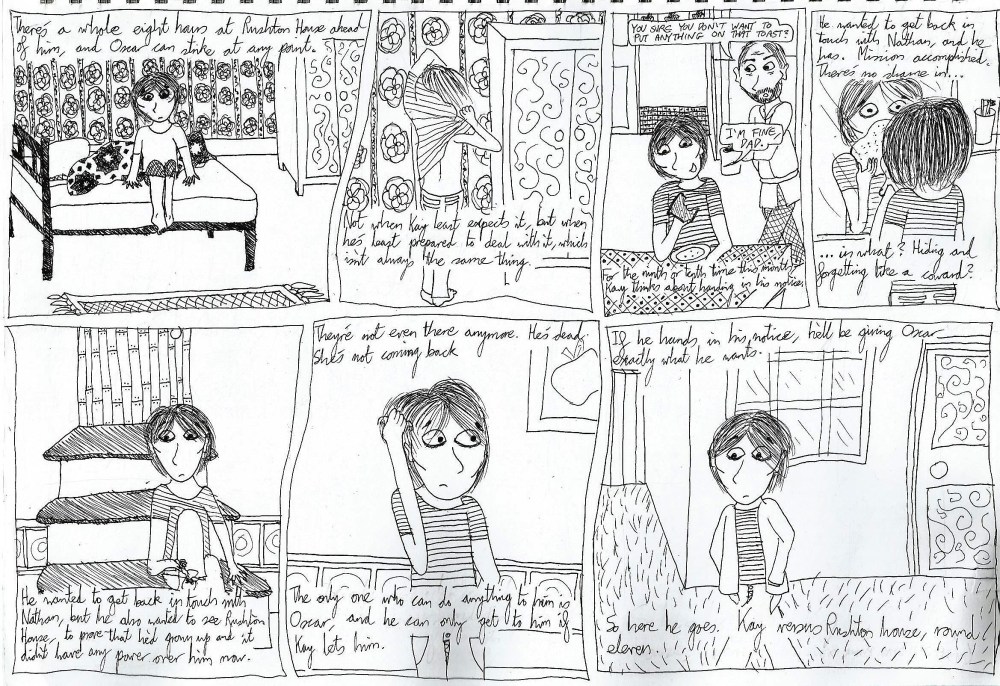
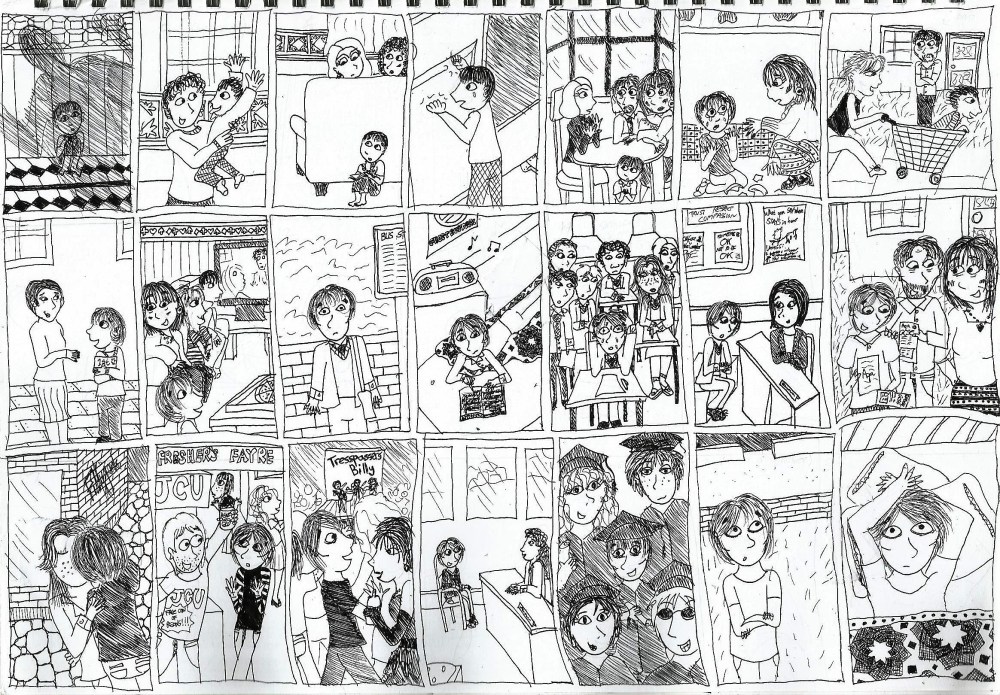
(This is part of “The Lazenby Family Papers,” two years late.  And since it’s been a while, I’ll repost two relevant pages, for context: )

On the day the Farrow family visited the Police Open Day, Lee was seven and his sister Polly was four.  It was almost ten years since their uncle, Johnny Farrow, disappeared into Haven Valley Stream.

If you drove for too long, like Grandpa was doing now, it got dark and the stars started shining in the sky.  And then if you didn’t watch the road under your wheels, it started to curve up, and soon you were driving up to the stars, right up in the Milky Way.  What was there to do up there?  Nothing much.  Look at galaxies, mostly.  Trail around the swirls and dots until you got bored.  Nothing much up there in space.  People kept going there, but Polly didn’t know why.

Polly pressed her nose into Spike’s fur.  Spike smelled the same, no matter what had happened or whether he’d been washed that day, and it always made her feel better.  Even if everything outside turned into blackness and stars.

It wasn’t a school day, but Grandma and Grandpa had still woken Lee up early.  They’d rushed him through his breakfast (no time for cream on his Coco Pops his morning), got him dressed in double-quick time, stuffed him in the car and zoomed down the motorway.

“Where are we going?” Lee asked.

Grandma turned round in her seat just so she could give him an angry look.  “Lee, for goodness’ sake, I’ve told you a thousand times!  We’re going to the Police Open Day!”

It was probably true about telling him a thousand times, but he still had no idea what he was going to find when he got there.  “What is a Police Open Day?”

Grandma made a noise and turned back around to look at Grandpa.  Lee looked back at his book.  It was called “The Happy Prince,” and it was about a statue that had come to life and made friends with a bird.  Next to him, his sister was playing with her cuddly hedgehog toy, pressing it up to her face as if she was trying to eat it.  Lee used to put his toys in his mouth all the time, but he didn’t do that anymore.

Grandma was talking to Grandpa.  She wasn’t whispering.  She probably thought she was, but Lee could hear her from all the way in the back.  “Remember last year?  They told us they’d come right up until the last minute, and then they backed out.”

“I remember,” said Grandpa, not taking his eyes off the road.

Other commitments, they said.  Brett knew how important it was to us.  But he had to listen to That Woman, didn’t he?”

Whenever Grandma said “That Woman,” she meant Lee and Polly’s mum, who’d moved away last Easter.  Brett was their dad, who’d sent them to live with Grandma and Grandpa because he Couldn’t Cope.  Grandma got upset and not-whispery whenever she talked about them, but at least she could still say Dad’s name.

“And now look at them,” sighed Grandma, “No idea why this is so important to us.”

Lee carried on reading his story.  At the end, the statue and the bird both died (the statue had already died once before, but this time it actually counted) and went up to Heaven, where God said that the bird would sing hymns to him forever.  Lee wondered if that was all you did in Heaven.  Wouldn’t your voice get tired?

Grandma turned back to them.  “We’re going to the Police Open Day because your grandpa’s best friend used to be a policeman, and he’s giving a speech.  We go there every year, just to say hello to him.”

“OK,” said Lee, “How long do we have to stay there?”

Grandma made a face.  “You are the rudest person I know,” she hissed, and turned back around to not-whisper to Grandpa instead. Lee looked back at his book.  The next story was about a giant.

There was a map on the side of the fence.  Polly had seen it before, on one of the morning programmes Mum had always watched, glowing with warm yellow light.  It was Great Britain- Scotland at the top, Wales at the side (Polly had always wondered how all the whales had got there, if there were so many that the whole country was named after them), and England in between.  It looked like a person with wild hair and stubby arms, looking at a little Scottie dog (even though that bit was Ireland, not Scotland).  It looked a bit strange, and Polly wasn’t sure if she trusted it.  They said that was where she lived, but that wasn’t what it looked like from here.  But from here, it looked too big to fit on the side of a fence, so maybe that made a difference.

Grandma pulled at her arm, and Polly followed.  She kept her eye on the map until it got too small and disappeared behind her.  Maybe if she kept looking at it, she’d see what she was supposed to, and work out how it looked like home.

It seemed like they were stuck in the queue for the tickets forever, but then they got into the big field where all the tents and displays were, and Lee wanted to run around and see everything.  There was music coming from somewhere, and he could smell fast food on the air (not that there was much chance of him getting that- Grandma never let them.)  There were shops where they sold little plastic toys, and stalls where you could throw balls at targets and win prizes, and people everywhere, looking happy and exploring.  Polly looked around with big, bulging eyes, the hedgehog still held up to her face.

Polly had never had an ice cream like this before, a twin ice cream, red and fruity but with two sticks coming out of it.  She had a toy at home, Garfield driving a special kind of ice cream van that was on a bike, and he sold ice creams just like this one. You could see pictures of it on the side of the box.  Spike looked at it hopefully, but if he had any it would go all over his fur and make him red and sticky and weird-smelling.  Polly was going to eat it all herself.

A strange, red, cartoon ice cream come to life.  That meant that anything could come to life here.  This was a magical place.

Grandma and Grandpa walked fast.  “He’ll be by the dog training tent,” said Grandpa, pointing at the other end of the field.

“You said that wasn’t ‘til later,” said Grandma, pulling Polly along like a wheelie-bag.

“It isn’t, but that’s where he’s going to be.

“Well, that’s what you said last year, and look what happened.”

Just then, Lee saw the most wonderful thing.  It was big, shaped like a double-decker bus with nets on the windows, and it was full of children.  Lee couldn’t tell whether it was a ball pool or a bouncy castle (or both), but it looked amazing.

“I just want to be able to eat this time.”

“Oh, for God’s sake, Dorothy!”

It was so big, it seemed to have enough room for every child in the world.  He could hear the screams and the laughter coming across the field, all the other kids enjoying it.  He could be there in seconds, among the big cartoon cardboard cut-outs and the weird rubbery smell.

Suddenly, Grandma stopped in her tracks.  “Lee, where’s your sister?”

Lee hadn’t even thought about Polly since he’d caught sight of the big double-decker bus.  He looked around, and saw nothing but a crowd of adults, all of them two or three times taller than Polly.  She could have been hiding behind any of them.  She could have gone anywhere.

Grandma could see by the look on his face that he couldn’t find her.  “Lee, you were supposed to be looking out for her!” she snapped.

“I’m sorry!  I was just looking at that big bus over there!”

Grandpa shook his head.  “Brilliant.  That’s all we need.”

“Well, go and look for her, then!” Grandma told him, pointing at the crowd.  Lee didn’t know where Grandpa was supposed to start looking.  It went on for miles and miles.

Grandpa threw up his hands and went off in a random direction.  Grandma pulled on Lee’s shoulder, and they went on walking.

The colours were bright, like you got in cartoons, brighter than they were supposed to be in real life.  There were people crowding round and throwing balls to win cuddly toys.  Polly thought Spike might want to see the other toys, so she put him up on the counter so he could get a good look.

There were some men next to her, throwing balls and laughing.  The one nearest to her was bald, not like Grandpa, who had a bit of hair around the side of his head, but all-over bald, like an alien.  He threw his shirt off his shoulders and wriggled his eyebrows.  You could smell him more strongly when he didn’t have a top on.  It was as if he was trying to get in through your nostrils and turn you into him.

Polly didn’t want to be bald and laughing and hairy-chested, so she ran.  There was a big patch of grass in front of her, so she went towards that.  Patches of grass didn’t try and turn you into something else.

Next to the big patch of grass was a wall, and in that wall was a door.

The door was old and mossy, set into the bricks like it was one of them.  It was a door with a curved bit on the top and a big metal latch.  Polly had seen a door like this in a book or on TV, and it was a special kind of door.  It was the kind of door that had mysterious, magical people and mysterious, magical things behind it.

It made Polly’s stomach jump a bit.  She stretched up on tiptoe and fiddled with the latch until it came open.

Through the door, everything was different.

There were faces on the wall, staring at her with open, stretching mouths and empty eyes, staring right at her as if they were trying to work out whether or not to eat her.  Polly knew she should be frightened, she should scream and run back through the door, but sometimes things like the faces on the wall didn’t do anything until you started running from them.  Until they knew you were scared.  So she walked past them with her head held high, and the faces in the wall kept staring but stayed where they were, in the wall, where they couldn’t hurt her.

The wall ended and the faces ended with it.  Polly found herself looking at a little clump of trees, with a wooden platform in the middle.  Behind the platform was a big bit of wood with pictures of the moon and the stars.  The moon had a smiling face on it, with big cheeks and a big chin.

There was a woman standing at the side of the platform, and she waved her hands so that Polly knew to climb the steps up to the platform and talk to her.

As soon as Polly got up there, she asked, “Do you live on the moon?  Is that why you’ve got pictures of it just behind you?”

The woman laughed.  “You could say that.”

Lee and Grandma had been sitting next to the dog-training tent for what felt like hours.  Grandma didn’t want to eat lunch or go and look at the shops until Grandpa came back with Polly.  Instead she sat on a chair, arms folded, sometimes looking at her watch and making huffing noises, and sometimes looking at Lee and saying things like, “Couldn’t you have kept an eye on her for five seconds?”

Lee sat beside her, wishing he had his book with him.  He wanted to see what was going to happen to the giant and those kids who kept sneaking into his garden.  All he had to look at now were the people standing outside the tent.  There had been some dogs earlier, too, but they’d had to go back in.  And you couldn’t stroke them anyway because they had a job to do.  You couldn’t do anything fun round here.

The woman said she knew Polly’s uncle.

“Uncle Johnny died,” explained Polly, remembering what her grandma and grandpa had told her, about how he was in Heaven, springing through the sky after Polly’s friend’s pet dog, waiting in an old train carriage like the one in the photo Grandma showed her of the olden days.  Uncle Johnny had been here, once (when Polly and her brother weren’t), and now he wasn’t.  The woman couldn’t know Polly’s uncle.  Not any more.

“Die?” said the woman, smiling in a way that showed some of her teeth.  She had long black curly hair, and purple eyeshadow going straight up to her eyebrows.  She was all in dark red and dark purple and dark black, like she was a shadow that had come to life.  “Die?  Johnny Farrow?  That’s the last thing he’d do.”

The woman smelled like expensive sweets, like in that shop Mummy had taken them once where the windows had been made out of curly black metal and everything inside looked like the olden days again.  Like that train carriage in the photo.  Like Heaven.

“Come back and see me before you go home, OK?” said the woman, “Bring your brother, too.  I’m always up for meeting a relative of Johnny’s.”

“OK,” said Polly.  She stood up, dusted herself off, and set out to find the door again.

 Finally, Lee spotted them on the horizon.  “Grandpa’s coming!  He’s found Polly!”

Grandma jumped to her feet and strode out towards them.  Lee hurried to catch up with her.

She finally reached Grandpa, who looked like he was pushing Polly along as he went.  “Well?” asked Grandma, “Where was she?”

“Back by the ice cream van.”  Grandpa nudged Polly towards Grandma.  “I suppose we’ve missed Mike’s speech?”

Lee looked at Polly, and frowned.  She didn’t look upset or anything, but something wasn’t right about her.

“It ended ten minutes ago.”  Grandma crouched down and clamped her hands onto Polly’s shoulders.  “We are very, very disappointed in you.  We’ve had to spend all day looking for you.  All the things we wanted to do today, gone.”

Lee realised what was bothering him.  “Polly, where’s…?”

“Spike!” gasped Polly, twitching her arms as if she thought she could find him just by doing that.

Grandpa scowled.  “That’s what you’re worried about?  No ‘sorry’?  No…”

“We’ve got to find Spike!”  Polly’s eyes were wide with horror.  She shook Grandma’s hands off her shoulders, probably without even noticing that she’d done it.

“We haven’t got to do anything, young lady,” said Grandma, putting her hands back and pulling Polly towards her, “We’re about ready to go home, thanks to you.  You’ve ruined our entire day.”

Grandpa shook his finger at her.  “If we’d had any idea how you were going to behave today, we’d never have let you…”

“Spike!” wailed Polly, tears springing from her eyes.

Grandma put her hands on her hips.  “Polly, I swear to God, if we do find that thing, it’s going right in the dustbin as soon as we get home.  You don’t deserve…”

Lee had never heard Polly make a noise like the one she made then.  It sounded more like a howling dog than an actual human girl.  Even Grandma shrunk back from her for a second, and in that second Polly was gone, through the crowd of people and over the horizon.

Lee took off after her.  Grandma had been right, earlier- he was supposed to be looking after her.  He wasn’t going to let her disappear again.

He managed to keep up with her, and they ended up at one of those booths where you could win prizes.  The man running it saw them coming.  “Hello, there!” he called out to Lee, “I was wondering if I’d see this little lady again!”  He reached below the counter, pulled something out and held it up in his hand.

“Spike!” cried Polly in wonder.

The man grinned.  “I hoped you’d be back for him.  He’s been keeping me company here since you left.”  He handed Spike to Polly, who held him up to her face and nuzzled into his fur like she was trying to merge with him.  The man looked up at Lee.  “You her brother?  Make sure she doesn’t lose the hedgehog again before you get home, OK?  He’ll start to feel neglected.”  And, smiling at them one more time, he went off to talk to some people at the other end of the booth.

Lee tapped Polly on the head.  “Come on, Polly.  Let’s go and find Grandma and Grandpa.”  He’d expected them to follow him, but they hadn’t.  Maybe they’d tried to and got lost?  It was probably a lot harder for grownups to move around if they couldn’t fit in smaller spaces.

Polly looked up a little, just so Lee could see her eyes over Spike’s fur.  They were the angriest he’d ever seen.  “No,” she mumbled.

“What?  Come on, we need to go home.”

“Grandma said she was going to throw Spike in the dustbin!”

“She didn’t mean it…” said Lee, but he knew she probably had.  She’d thrown things away before, when she was mad.  “But we’ve got to go home…”  Home was cold now.  It had been cold when Mum had moved away, and it hadn’t got any warmer when they’d gone to live with Grandma and Grandpa.  It was cold and dark and empty, and no-one wanted you to be there.

Lee looked at Polly, and shrugged.  “We’ve got to go home,” he told her, “Where else can we go?”

Polly kept Spike pressed to her face for a few seconds, then lowered him down so that Lee could see her whole face.  “I know where,” she told him.

Polly led Lee to the door.  The moon woman had said she wanted to meet him.  She’d said she wanted to meet Polly again.  She’d said she knew their uncle.  Polly didn’t mind what she said, as long as she took them to the moon with her.

They’d get in faster this time.  Lee was taller.  He’d get the latch open quicker.

Polly squeezed Spike tight in case she dropped him and lost him again.  She wondered what it would be like in space.

The End