girls (part nine)

 (pages 127-149)

Hubert’s at a nightclub with his girlfriend, feeling insulted when the DJ describes a ten-year-old song as a “classic.”  Look, if calling “I Predict A Riot” a classic is wrong, then I don’t want to be right.  He is taken aback to see a thirteen-year-old girl wearing an obscene T-shirt.  I’m not sure if the implication is that he’s having a sudden attack of conscience, or if it’s that he’s thinking, “See?  Teenagers talk about sex sometimes!  Therefore I am completely justified in trying to have highly exploitative sex with them!”

Hubert likes young girls because they’re the only ones who aren’t scared of him.  I think he’s mixed up “scared” and “repulsed.”

He meets a PVC-clad goth girl, and stares at her boobs.  He sees her again a couple of times throughout the evening, which makes him think about how fat his girlfriend is going to get as she gets older.  Hubert himself is already middle-aged and bald, but apparently that’s not important.

The band they’ve come to see pulls fourteen-year-old boys up on stage, gets them to take their shirts off, and encourages the audience to ogle them.  Hubert is turned on.  He is NOT GAY, you understand, just happy for the boys because they got to be felt up by older women.

Hubert has a friend who regularly goes up to five-year-olds and tells them how much he fancies their mothers.  Strangely, this friend isn’t in jail.

There’s a bit about women in Russia who resorted to prostitution after the Soviet Union collapsed, and how men would flock to Russia for the chance to humiliate a well-educated woman who now couldn’t get a job.  The narrator (who is presumably neither Hubert nor Business Cat, owing to this whole bit being in third-person) worries that some of these women might have faked their qualifications, meaning that the poor men who wanted to degrade a former university professor were tricked into degrading a former shop assistant or something.   Unethical business practices are a terrible thing.

Business Cat’s wife redecorated their flat while he wasn’t there.  How very dare she.

Hubert once had a dog.  Sorry- Hubert might have once had a dog, since saying anything happened for certain would be dangerously close to having a plot, and we can’t have that.  Anyway, Hubert loved his hypothetical dog, but worried that one day he and his dog would swap places and the dog would be the one to decide where he ate and slept.  I’ve got to say, I’d probably trust the dog’s judgement more.

Hubert’s now been divorced twice.  Big shocker, I know.  He asks his friend how his marriage has lasted so long, and it turns out that it’s because his wife lets him have threesomes with eighteen-year-olds.  This is getting really monotonous.

Back in university, Hubert set his friend up with a girl so that he could lose his virginity.  We find this out in the first sentence of this section, but Hubert still takes a page and a half to tell us.

“The Romans didn’t believe in Justice more than the early Greeks, they simply realized its usefulness.  They realized while a man fights well for something he wants, he fights even better for something he thinks he deserves.”
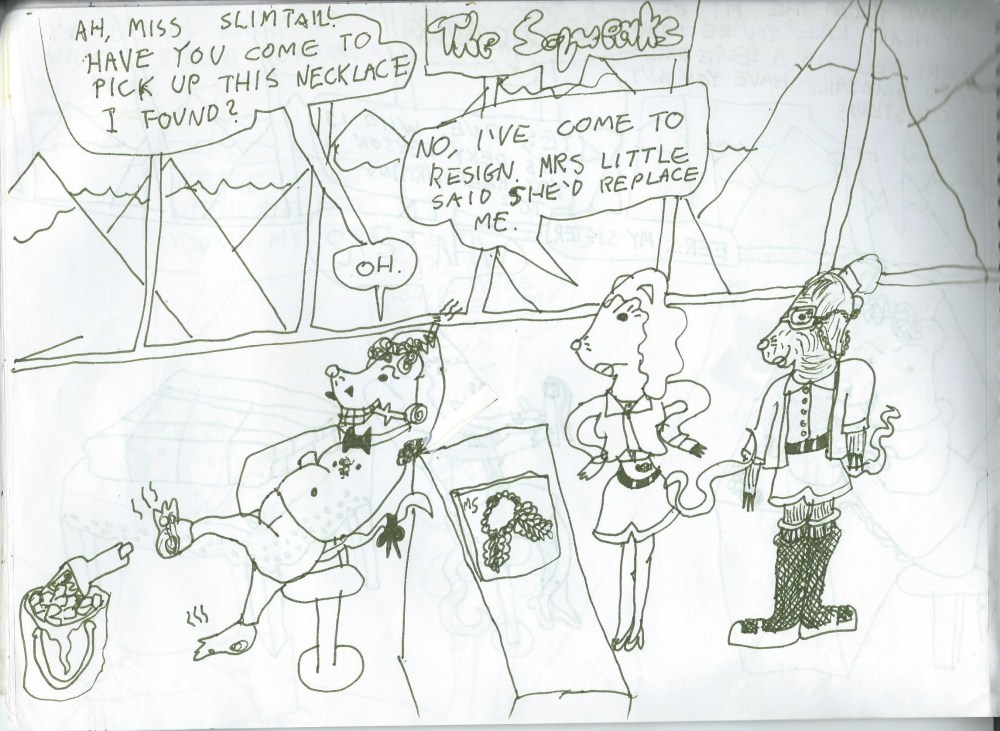
DL1

Everyone is afraid of Hubert, even his parents.  He thinks it’s because he’s become so rich and powerful, but I think it’s just because he’s Hubert.

Oddly enough, there’s now a bit about Lolita.  I swear I didn’t know this before I wrote the last post.  Anyway, apparently Nabokov wimped out by making Lolita twelve rather than, say, eight, because that made the book less shocking, because we all know that all men fancy twelve-year-olds anyway.  I think Nic Kelman might have missed the point of the book.

Business Cat denies that he hates women.  No, you just want to make them into lobotomised sex-dolls who conveniently disappear as soon as they turn thirty.  Nothing hateful about that.
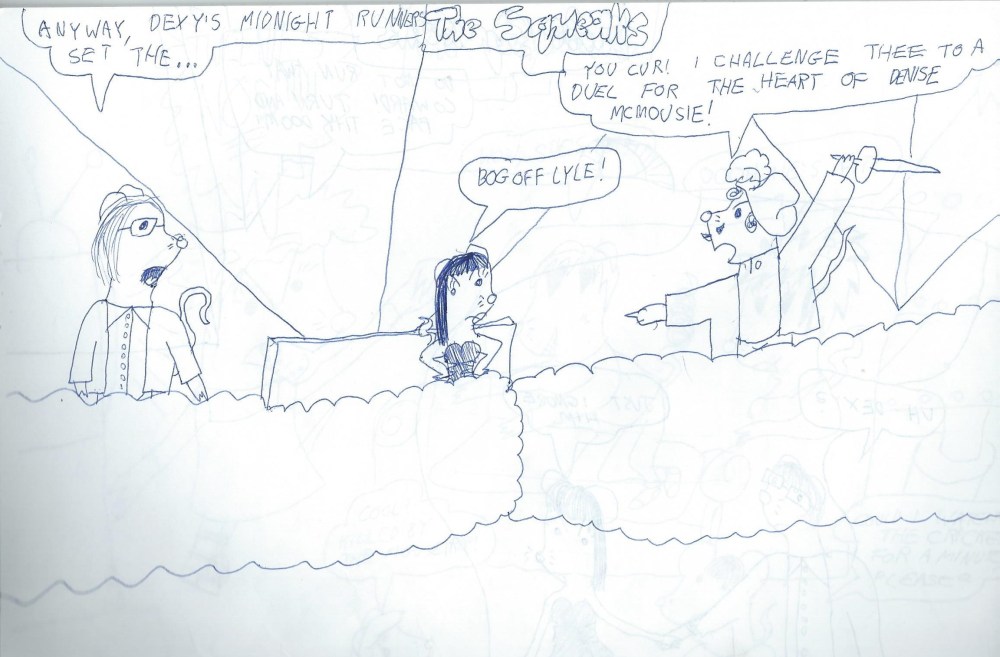
DL7

girls (part eight)

(pages 110-127)

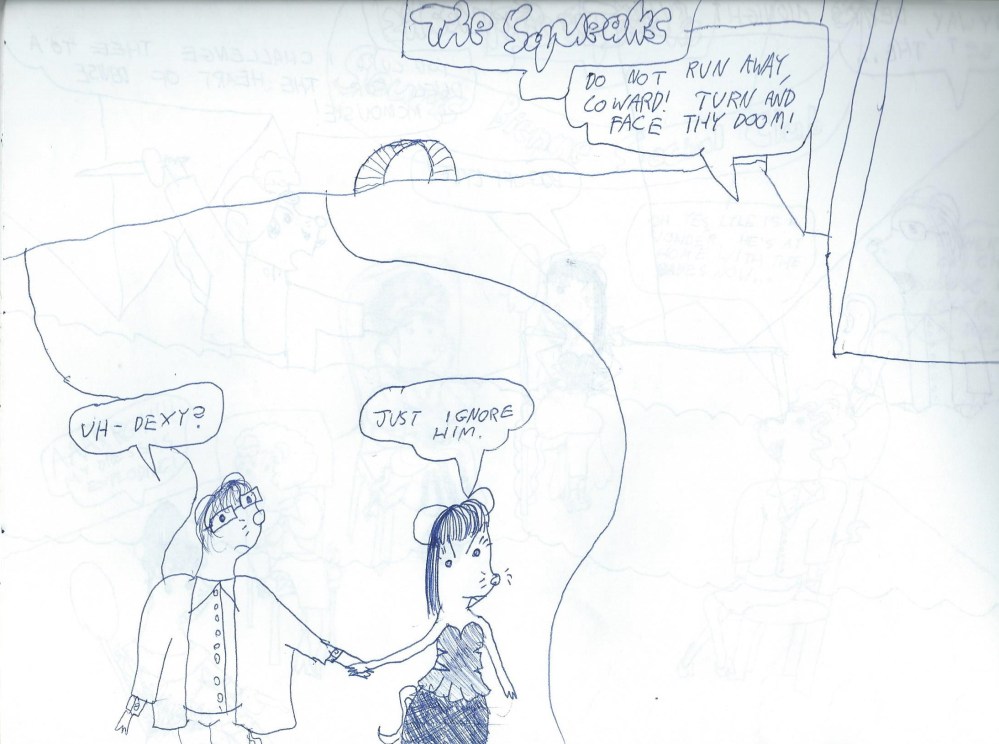
DL11

More than once over the last couple of weeks, I’ve described this book as “a bit like Lolita, only crap.”  Of course, the important thing about Lolita is that it has an unreliable narrator, a guy who convinces himself that he’s a bold romantic hero, only to realise near the end of the book that he’s actually just a scuzzy little sexual predator who has ruined the life of the girl he claims to love.  I’m looking forward to Hubert and the first-person narrator having a moment like that.  I hope they’re going to, anyway, because at the moment girls is looking an awful lot like a literary version of this.

Speaking of the first-person narrator, I’m still not sure what to call him.  I’m torn between King Dong (because of his great thoughts on how men have more in common with gorillas than with women) and Business Cat.

Hubert’s employees gossip about him behind his back.  You would too, if your boss was Hubert.  Specifically, they talk about the time he fell out with his business partner, who then shot himself.  Honestly, that strikes me as the least gossip-worthy thing about Hubert, but to each his own.

We also find out that Hubert’s wife has left him.  Good for her!

Something about Paris killing Patroclus in The Iliad.  You know, I think I’m going to skip the Iliad quotations from now on, unless they’re particularly juicy.  They rarely have anything to do with what’s actually going on in the story.  Such as it is.

Hubert is travelling the world, eating guinea pigs.  As if we didn’t already know that he was history’s greatest monster.  Oh, and he also finds kinship wherever he goes with other men who like to sleep with teenage girls.  It’s nice to find something that transcends cultural borders.

Business Cat (it’s the classier option) talks about his wife kissing him goodbye in the car instead of in front of his mates, who might make fun of him.  The he talks about the origins of the C-word, and how it was Homer who started using it as an insult for women, so blame him.  It’s funny; where I come from, the C-word is almost always used as an insult for men, not women.  In fact, for a few years in the early 2000s, I only ever heard it applied to Tony Blair.  It was like his own personal insult.

Also, the C-word is related to “cunning,” which makes sense because women are crafty bitches.  Trufax.

Hubert has a female friend.  I know- I’m as surprised as you are.  The book does specify that she’s the only one, though.  I mean, let’s not go nuts.  He’s surprised to find that he’s attracted to her, even though she’s his age.  Surreal!

He doesn’t enjoy sleeping with her, though, so that’s alright.  It turns out that she also has a thing for teenagers, and enjoys it when her boyfriends end up sleeping with Hubert’s girlfriends.  The phrase “wind them up and watch them go” popped into my head when I read that bit, and I’m still shuddering.  But still, Hubert looks down his nose at her because she just sleeps with teenagers for “aesthetics,” not for philosophical reasons like he does.  Hubert the hipster perv!

Hubert denies hanging around outside local schools.  He very specifically denies it.  Why would you suggest such a thing?  Honestly…

Let’s see…  Men admire villains because they dominate people…  Hubert used to believe that his face would stay that way if the wind changed…  Business Cat associates his wife with temples…  I’m not seeing much of a connecting theme, here.  See, this kind of thing is what I mean by “like Lolita, only crap.”  Lolita had an actual plot.

Finally, Hubert meets a gay person who is into teenagers as well, which makes Hubert decide to extend the hand of brotherhood.  It’s a beautiful story of social acceptance.

DL3

girls (part seven)

We’re nearly at the halfway point now, and, so far, I’m not seeing the transgressive beauty that J.T. LeRoy and the others were raving about on the back cover.  If you’re just joining us, we’ve been through ninety pages of Hubert Pubert and the first-person narrator, who may or may not be a) the same person or b) intended to be remotely sympathetic, trying to compensate for their many, many inadequacies by dating girls who are too young and naïve to realise they could do better.  Occasionally they wax lyrical about how they are men and therefore warriors and they seek power as their birthright.  If I wanted to read in depth about people like that, I’d spend an hour looking through the We Hunted The Mammoth archives.

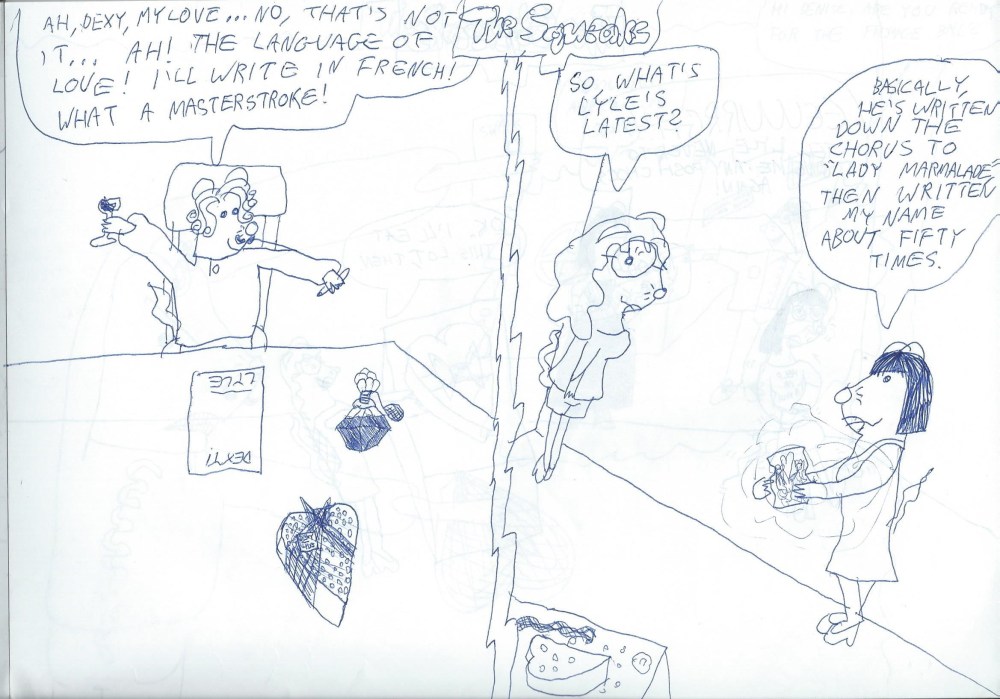
DL12The above is a cartoon I drew when I was fourteen.  Clearly, my Year Nine rough book deserved excited back-cover cover quotes from memoirists who fib a lot.
Back in the book, Hubert reminisces about his bisexual ex-girlfriend and how they once had a threesome with her ex.  Then there’s a bit from The Iliad about a guy whose mother made him seduce his father’s mistress in order to stir up trouble.  Now why can’t I be reading that story instead of about boring old Hubert?

Hubert compares his girlfriends’ political beliefs to small children getting excited about pointing out fire hydrants.  You might think that this is patronising, but when you know what’s coming up in a few sections, you’ll see that it’s actually horrifying.

Hubert has a daughter who is older than his girlfriend.  He makes her work his law firm, within reach of his slimy friends.  Ick.

There’s a bit about the lamia, who is known for drinking men’s blood.  And yet I know that this book isn’t going to end with Hubert and his mates being exsanguinated by one, so why are you taunting me, Nic Kelman?

The first-person narrator blames his divorce on the fact that he and his wife never went to museums anymore.  Nothing to do with the fourteen-year-olds, then.  Sooner or later I need to come up with an insulting nickname for this guy, too.  What can it be?  Herbert the Pervert’s already taken.

There’s a bit about how proud Hubert’s dad was that he was a total horndog as a kid, and another bit about strippers and porn stars and how they’re actually complex human beings, you know.  As long as they’re under thirty, I guess.

(Actually, I completely agree that it’s wrong to dismiss somebody’s intelligence and worth as a human being just because they’ve got a slightly raunchy job.  It’s just that when someone like Hubert tells you how intelligent and grounded most strippers are, it always comes with the implication that, if you were intelligent and grounded, you too would give him a lapdance whenever he asked.)

Hubert is in Amsterdam.  Guess what he’s doing.  Go on, guess.  You know, in How Not to Write a Novel, they warn against something called “The Second Fellatio in the Laundromat”; i.e.- when one sex scene is functionally identical to another one earlier in the book, and only really exists to provide padding.  That’s this scene in a nutshell.  This prostitute is also underage (or rather, would be underage in the US, where Hubert lives), and Hubert again congratulates himself on being so adventurous.  He reflects that she was probably abused as a child, and also that she’ll be surprised when she’s twenty and men find her less attractive.  He gives her a bit more money than he needs to, by way of charity.  I’m pretty sure Hubert’s still alive at the end of the book.  There’s no justice.

There’s a sentence that begins, “There is so much sociobiology I cold bore you with.”  For “could,” read “will,” and for “bore you,” read “make your synapses shut down in self-defence.”  But anyway, apparently men have more in common with gorillas than they do with women.  Well, gorillas have tiny penises, so that’s true for Hubert, at least.

Hubert’s friend is dating an eighteen-year-old model.  Hubert is also dating various eighteen-year-olds, but becomes jealous when he hears that his friend’s girlfriend collects cuddly toys and makes him “pinkie promise” to call her.  She’s so childlike and charming!  That’s totally not a creepy thing to find attractive in somebody already younger than your daughter!

(I’ve never once met an eighteen-year-old who used the phrase “pinkie promise.”  Honestly, I’m not sure I’ve met anyone over thirteen who used it.  And then only the really annoying thirteen-year-olds.)

Hubert’s friend feels a bit guilty for dating an eighteen-year-old, but Hubert thinks, “When he realises that this is something he not only needs but deserves, he’ll stop feeling bad.”  In Hubert’s worldview, his friend deserves to be with an eighteen-year-old girl who talks and acts like she’s twelve.  This is what the universe owes him.  I’ve read books about actual, real-life serial killers that have creeped me out less than this.

More from The Iliad.  Achilles wants to kill Helen for turning men against each other.  Bros before hoes, eh?  Meanwhile, Hubert is impressed by another friend’s beautiful, subservient girlfriend, and even more impressed that said friend is secure enough in his relationship to call her fat in front of his friends and refuse to acknowledge her otherwise.  Finally, we find out that the divorce rate for veterans in the US is no higher than the national average.  Good for them.

The first-person narrator says that it’s a parent’s job to teach children to be competitive.  In particular, it’s their job to teach their daughters to compete with other young, pretty girls for the attention of old, grimy men.  Seriously, My Friend Dahmer is a million times less creepy.

There’s then a bit about Elizabeth Bathory, who is also not going to kill Hubert.  Granted, I’m probably going to see every character who is introduced from now on as yet another person who isn’t going to kill Hubert, but I know for a fact that Elizabeth Bathory has both the means and the motive.  It’s a shame to see a genuine talent go to waste, that’s all I’m saying.

And with that, we reach the halfway point, and I think I’m going to take a break from this for a week.  This book is seriously getting me down, and this was the worst section yet.  There’s only so much time you can spend in the head of a misogynistic borderline-paedophile before you start to lose faith in humanity.  I’m going to spend some time with The Restaurant at the End of the Universe, reminding myself that sometimes books have an actual plot, sometimes characters aren’t completely reprehensible in every way, and sometimes sentences contain actual humour instead of condescending pretension.

“The average Vogon will not think twice before doing something so pointlessly hideous to you that you will wish you had never been born- or (if you are a clearer-minded thinker) that the Vogon had never been born.”

Ahhh.  See you next week.

DL4.jpg

girls (part six)

We discover that Hubert doesn’t enjoy sex unless the women he’s with let him rough them up a bit and call them whores and bitches.  Surprise.  He also acts sniffy about the concept of “women’s liberation.”  Double surprise.  I mean, it is a movement based on convincing women that they have options in life beyond catering to the whims of Hubert and his pals.  I can see how that would annoy him.

The first-person narrator remembers buying a house with his wife, resenting the fact that she chose most of the furniture, and having sex in every room.  Following this, it’s The Iliad again, with Achilles lamenting over Briseis.  Then Hubert worrying about his love-handles.  One of these things is not like the other.

Also, it’s OK to cheat on your wife because everybody does it.  And rich men pay assistants to distract their wives from the fact that they’re cheating on them, so that’s doubly OK.  Good to know.

Hubert wanks over a photo of his underage girlfriend.  We finally have a confirmed age for him- forty-two- which just makes me wish I was reading Hitchhiker’s Guide to the Galaxy right now.  Arthur Dent is more man than Hubert will ever be.

More from The Iliad, then we have Hubert on holiday with his long-suffering wife.  He has a fancy new camera.  He is very proud of his fancy new camera.  His wife shows off the fancy new camera to another couple.  Hubert suspects that the husband is jealous because he cannot buy his own wife a new camera as fancy as this one.  After they’ve gone, Hubert’s wife refers to then as “a nice couple,” but Hubert knows his wife is foolish, because the husband is jealous of his fancy new camera.  This is beginning to sound like something from Clickhole.

There’s a bit about people going to see graveyards and monuments while on vacation.  I think it’s supposed to be profound.

Hubert goes to New Orleans.  You have probably guessed that he meets a beautiful young woman who is inexplicably attracted to him, and you would be correct.  Her name is Elena, and he knows her from a modelling shoot a few years ago.  We’re told that he only went after her because she’d been seen with another man previously.  I’m not sure if we’re meant to read this as jealousy or homoeroticism.  Could be both.

In the present day, Elena seems upset about something.  She married the other man instead of Hubert, and now he cheats on her.  Hubert, meanwhile, has a much younger girlfriend who thinks Elena’s top is too low-cut.  The moral of the story is, never dump Hubert.

The first-person narrator and his wife skip work and go for a romantic drive.  He assures us that he never really loved her.  There is then a discussion of the various meanings of “love,” and how it’s really about owning things.  Woman are things, after all.

girls (part five)

(pages 48-71)

There’s a description of a sixteen-year-old pop star who is totally not Britney Spears, what gave you that idea?  She denies being a sex object, and “you” laugh, because she wears short skirts and therefore only exists to titillate middle-aged men.  Stands to reason.

“You” reflect on “your” midlife crisis, and how bungee-jumping didn’t make you feel alive but sleeping with an underage prostitute did.  You know, it’s getting kind of tiresome, typing “you” over and over.  If the book doesn’t give this second-person character a name soon, I might have to give him one myself.  I’m thinking something along the lines of “Hubert Pubert.”

We then get another quote from The Iliad, with Helen describing herself as a “nasty bitch.”  Cheer up, Helen- you’re not half as nasty as old Hubert here.

Hubert takes a younger woman he plans to sleep with (is there any other kind?) into the Versace Boutique to buy her stuff.  The manager won’t let them in while they’re eating pretzels, so Hubert bribes and bullies him into doing so.  Hubert inwardly laughs at the manager for allowing him such a victory, but is then insulted that the girl finds it funny.  Hubert doesn’t have much of a sense of humour, I’ve found.  Then there’s a quote from General Lee on the nature of war.  Because acting like an entitled dweeb in a clothes shop is exactly the same as leading men into battle.  At least Hubert wasn’t doing it to defend his right to keep slaves, I guess.

Back to the first-person narrator, who also doesn’t have a name yet, remembering himself and his wife being scared by a mouse on their wedding night.  His wife asks him to deal with it, so he smashes its head in with a table leg.  Again, also not the same thing as going into battle.  Maybe if the mouse was armed with a bazooka.

Another quote from The Iliad, with Aganemnon resolving to give Briseis back to Achilles, and then we have Hubert deciding not to discuss his business practices with his girlfriends, so as not to sully their innocent minds.  One of these girlfriends was an underage prostitute.  I’m never going to get tired of pointing that out.

There’s a bunch of statistics regarding the sex industry, concluding, “All told, the American male is clearly not getting what he wants at home.”  Not least because what he wants is teenage girls to fawn over him, and, in real life, they’re annoyingly reluctant to do so.

At work, Hubert wears a bracelet his girlfriend bought him, and is embarrassed when his friends notice.  Hubert imagines that the teenage girls he letches over are just as interested in him, and that their frustrated, cheated-on mothers are angrier with them than they are with him.  The first-person narrator is angry that his wife taught him a trick for using vending machines, and now he can’t ever forget about her because it will mean forgetting how vending machines work.  This is the kind of thing they’re comparing to a ten-year battle against Troy, by the way.

There’s a list of words to do with love and addiction, thus comparing the two.  This is a very original thought.

There is then a strange section that states that people who grow up in poverty and whose sisters become disabled because of this are luckier than people whose children don’t end up at the right university, because they’ve found out earlier on that the world is a harsh and cruel place.  Also, making lots of money and only dating women who are too young to see what an idiot you are is exactly the same thing as “lead(ing) armies into Gaul.”  Just watch out for those bazooka-wielding mice, I guess.

There’s a section that begins:  “Have you ever seen a domesticated dog with its first bone?”  I’m not sure why the narrator felt he had to specify “domesticated.”  Maybe he was worried that the readers wouldn’t know what a dog was.

Hubert is admiring his expensive new car, congratulating himself for not being one of those stupid people who refers to cars as “she.”  There are problems with work, but, on the bright side, he seems to have a wife now.  She doesn’t nag him like his friends’ stupid, awful wives, but he’s still unsatisfied.  Probably because she’s not fourteen.

Hubert drives away from his house to a nearby bar, where a group of college girls ask him about his career and hang on his every word.  They are impressed by his house and his car.  One of the girls takes him back to her room, and is much better in bed than his wife.  Geez, and people called Twilight wish-fulfilment…

girls (part four)

(pages 32-48)

It occurs to me that, in a previous entry, I said that this entire book is in second-person.  After my first flick-through, I genuinely thought it was.  But then, a few days ago, I hit a first-person section and realised my mistake.  It would really have been more accurate to say, “more of this book than I can tolerate is in second-person.”  Camel Without enterprises sincerely regrets the error.

We’re back to “you,” and “you’re” at a birthday party, fantasising about setting fire to the other guests.  Between this and the shooting fantasies earlier, I think “you” could do with a week or two of anger management.  Unless that was a different “you”- it’s hard to tell.  So far, the only character who has had an actual name has been the underage prostitute.  Her name was Jin.

“You” are out with “your” girlfriend, and preparing to meet an old high school friend.  Judging by the incredibly subtle Achilles/Briseis/Aganemnon-related foreshadowing earlier, I anticipate that the old high school friend will try and steal “your” girlfriend.  Apparently the friend was on the school football team.  Yep, definite girlfriend-stealing ahoy.  Maybe one of you will feed the other one to the alligator-farmer’s alligators.  I’d like that.

Hey, we have actual names!  Two of them!  The girlfriend is called Penny, and the high school friend is called Clay.  Penny asks Clay questions about his career with the police, and gets him to tell her embarrassing stories about “you.”  Instead of getting jealous, “you” start to have weird fantasies about watching Clay and Penny have sex.  That I did not expect.

Clay’s missed his train, so “you” invite him back to “your” place.  This leads to a threesome.  It gets quite homoerotic.  “You” go to sleep, patting “yourself” on the back for being so sexually adventurous, and then Penny sneaks off to have some more sex with Clay while “you’re” asleep.  They agree not to tell “you” about that part.

girls (part three)

(pages 21-32)

In the next section, “you” (possibly a different “you”) go out into the country to buy some land.  “You” gleefully fantasise about shooting intruders.  “You” then go out to dinner, and get annoyed because the waitress doesn’t fawn over “you” in the manner to which “you” have become accustomed.  Then a local alligator-farmer* comes along and kicks “you” out of your booth, thus establishing himself as my favourite character so far.  And the waitress actually does talk to him, completing “your” well-deserved humiliation.

There is then a section about animals with hooks on their penises.  Apparently, this is quite inconvenient.

The next section switches to the first person, which is handy because it means I don’t have to keep typing “you” anymore.  The narrator and his girlfriend are in France.  There’s a mention of their college years, which means that the two of them are about the same age, which probably means that she’s about to get cheated on with a fourteen-year-old.  There’s a weird bit where the girlfriend tries to get the narrator to drink champagne off her breasts, but then she pours it wrong and it ends up going all over the bed.  The narrator asks her to marry him, but then ignores her in favour of a report from work on the plane back.  Like I said, she’s gonna get cheated on.  Poor girl.

There is then another quote from The Iliad.  Like the last one, it’s about Achilles.  I’d have assumed that this was a reference to Achilles’ heel, and that the male characters’ lust for young women is supposed to be their one tragic weakness, but I’m not sure the story really supports that.  I mean, the guy from the last entry found that sleeping with underage prostitutes actually helped his career, so he’s not much of a cautionary tale.

Now we’re back to “you” again.  “You” wake up frightened in the night, after dreams of losing all your money and “fighting with a woman as old as you are about whether or not you can afford to see a movie.”  “As old as you are”!  The horror!

Anyway, “you” are in bed with a woman whose name “you” can’t remember.  The point is that she’s younger than you.  Oh, and she “find(s) you fascinating,” because that idea didn’t make me feel queasy enough in the introduction.  “You” angst about the fact that “you” have just slept with a young, pretty woman who clearly likes you.  “You” are such a tortured soul.  Luckily, in the morning, “you” see her walk naked to the shower, notice that she doesn’t have any “sagging flesh,” and immediately cheer up.

We get a strange witticism about running (apparently you shouldn’t talk and run at the same time), and then we’re back to “you.”  “You” are letting “your” new girlfriend take “you” to clubs, bars and cafes that “you” inwardly sneer at.  We are told that “you” love “your” younger girlfriend despite her terrible taste in date locations because “you” appreciate the fact that she isn’t jaded and bitter yet, but I think “you” just like having someone around who “you” can look down your nose at.

There’s a quote about Agamemnon taking the slave-girl Briseis away from Achilles.  The odd thing is, Briseis wasn’t hanging around with either Achilles or Agamemnon because she “found them fascinating,” but because she was, you know, a slave.  She didn’t have any choice.  This seems like an important distinction.

There’s another queasy bit about older men smiling patronisingly at their younger girlfriends’ ignorance.  Then we go back to first-person, and we’re talking about a divorce.  Surprise.

Guess why they’re getting divorced.  Go on, guess.  You’ll never get it in a million years.  (Hey, his wife deserved it, because she had small boobs and asked him annoying questions.  What was he supposed to do?)

Then the narrator describes teenage girls’ bodies as “freshly baked, ready to eat,” and I think I’m done with this for now.

girls (part two)

(pages 5-21)

First of all, this whole book is in second-person.  This is probably a bad move, because it leads to the reader saying unhelpful things like, “Wait a minute- I don’t have a penis, and even if I did, I certainly wouldn’t use it to do that!”  This takes them out of the story.

This is the first paragraph of the book:

How did they get so young?  These girls that only yesterday seemed so far away from us, these girls that seemed like another country.  Tell me, when did they become children?

Basically, a very pretentious version of, “That’s what I love about these high school girls, man. I get older, they stay the same age.”  The narrator goes on to tell us that the joy of them being “children” is that they don’t make emotional demands on you like those lousy rotten fully-grown women do.  Then there’s this:

And when did they cease to ignore us?  When did they begin to fawn over us?  When did we begin to fascinate them?  With our money and companies and perceived security.

At the risk of repeating myself, I have never once met a teenage girl who was attracted to men with “money and companies and perceived security.”  Decent abs, guitar-playing abilities and maybe a cool car, yes.  A position on the board of a major corporation, no.

In the next section, “you” meet a girl who “you” used to be involved with.  This girl has now grown too old to take “you” seriously.  This is clearly a great tragedy, and she should stop and re-examine her life.

Moving on, “you” are now a businessman who flies into Korea.  “You” inspect a ship, sack a worker and feel guilty about it.  “Your” girlfriend calls, and tries to comfort “you” with squicky baby-talk.  “You” are unmoved:

Mommies are for sick little boys.  You aren’t sick, you aren’t a little boy, you don’t need sympathy.  There is nothing tender loving care could do for you right now, right now there is nothing even your real mother could do to make you feel better.  She wouldn’t, couldn’t, understand what it was like any more than your girlfriend.

Nope, but an underage prostitute might!

That’s the gist of the rest of this section, to be honest- “you” sleep with an underage prostitute, comparing her favourably to “your” actual girlfriend all the while.  The next day, “your” boss, who gave you the number of the brothel in the first place, slaps “you” on the back and congratulates you.  The section then ends with a quotation from The Iliad, because this book is classy, dammit.

girls (part one)

deary deary me

The above is the back-cover blurb of Girls by Nic Kelman.  No, sorry- girls.  No, sorry- girls: a paean.  We must be accurate.

Note how, in the description, we are given three examples of older men who sleep with women who are too young for them (we all know that “a young woman whose true age he never learns” is a euphemism for “a girl who was probably underage,” right?).  Note how we aren’t told how the girls themselves feel about any of this.  Note how said girls are explicitly described as prizes and possessions.  Note how all the men are described entirely in terms of their financial success.  Note how we’re encouraged to compare this book to Ancient Greek literature purely on the grounds that it’s about dirty old men trying to get their end away.

Note also how two of the review quotes are from James Frey and J.T. LeRoy, two well-known biographical authors who were later found to be lying their heads off.  That has nothing to do with anything else- I just find it funny.

I was a teenage girl myself when this book came out, and it annoyed me so much that I bought a £1:99 copy from The Works in order to horrify my friends (none of whom, I assure you, had any interest in sleeping with their fathers’ grubby mates, even if they were wealthy CEOs.)  These days, I’m 29, and it still annoys me.  So I’m going to spend this summer reviewing it.  I’ll try to post twice a week, talking about twenty pages at a time, give or take.

And, after that, I’ll probably chop it to bits and turn it into origami swans.  Or maybe I’ll cover it with amusing graffiti and post photos.  It depends what kind of mood I’m in.


Ivy (part four)

My father and stepmother left me alone to climb the stairs to my stepbrothers’ room.  Alone, so alone I felt when they snuck into the dining room to argue about whether they could still use their Phantom tickets or not.  As I climbed, a small cry escaped my lips.  The carpet on the stairs was as thick as the moss on the windowsill of my dear grandfather’s shed, and exactly the same shade of purple.  In retrospect, his experiments with the weedkiller had always been a bit worrying.  Oh, poor Granddad!  If only he could have seen me in a house as wonderful as this!  Surely he would have wondered how his beloved shed would hold up in my memory, against such elegance.  Surely it must fade away, a dull, shabby thing, not worth remembering at all…

“I don’t care what wonderful things I see in this house!” I cried suddenly, “My heart will always belong to my dear Granddad’s shed, the place where it was formed!”

Just then, the door at the top of the stairs opened, and a boy poked his head out.  “Guys?” he asked, turning back into the room, “There’s some psychotic-looking girl out there yelling nonsense about sheds.  Do you think we should bar the door so she can’t get in and eat our brains?”

A voice from within said, “Dunno.  Is she hot?”

I reared myself up and barged through the door before they could bar it.  I reminded myself to be confident- after all, wasn’t I more or less an important member of…  Damn it, what was my dad’s last name?  I hadn’t thought to ask.

“Who the hell are you?” asked the boy who’d let me in.  I could tell by the slender lengths of his legs that he was tall, and by the yellowish hair growing out of his scalp that he was blond.  I stared at him, more than puzzled by the unexpected way my body responded just to the sight of him.

I began to tremble, threatened by his unwillingness even to say hello.  What would Tamsin do in this situation?  Certainly she wouldn’t let this boy intimidate her!  But I was….

“Um, I’m pretty sure she wouldn’t let me intimidate her, seeing as how she’s my mum,” said the boy, “Do you realise that you’re talking out loud?”

…but I was just a poor, naïve girl from Pitsea, and as yet I hadn’t yet learned how to be arrogant.

“She’s freaking me out, man,” said another boy from behind him.  I turned and saw a very tanned, dark-haired young man with his jawline set in a firm, determined way.  My heart fluttered as I met his eyes, those dark blue orbs that seemed to promise a world that I’d never seen…

“Don’t excite yourself, Angus,” said the first boy, and I whirled around to find myself lost in his smile.  I saw for the first time how broad his shoulders were, how the definition of his muscles were just visible beneath his thin shirt…

“I bet she’s one of those MI5 agents,” said a third boy.  He was short and spotty with bad breath, so I didn’t pay him much attention.

The first boy sighed.  His golden hair curled around his earls like some beautiful pieces of macaroni.  “Look, do you want to sit down?  We’ve ordered a pizza- you can share it if you want.”

“We’re watching Shaft,” added his brother, those beautiful eyes glinting in the dim light.

My eyes filled with tears as I sat down.  Annabelle and I used to order pizza and watch 70s Blaxploitation movies every Friday night.  Maybe now, in this strange place, I had finally found a little piece of home.

“You’re sitting on my leg…” said the third boy.  I shrugged and stole his share of the garlic bread.